
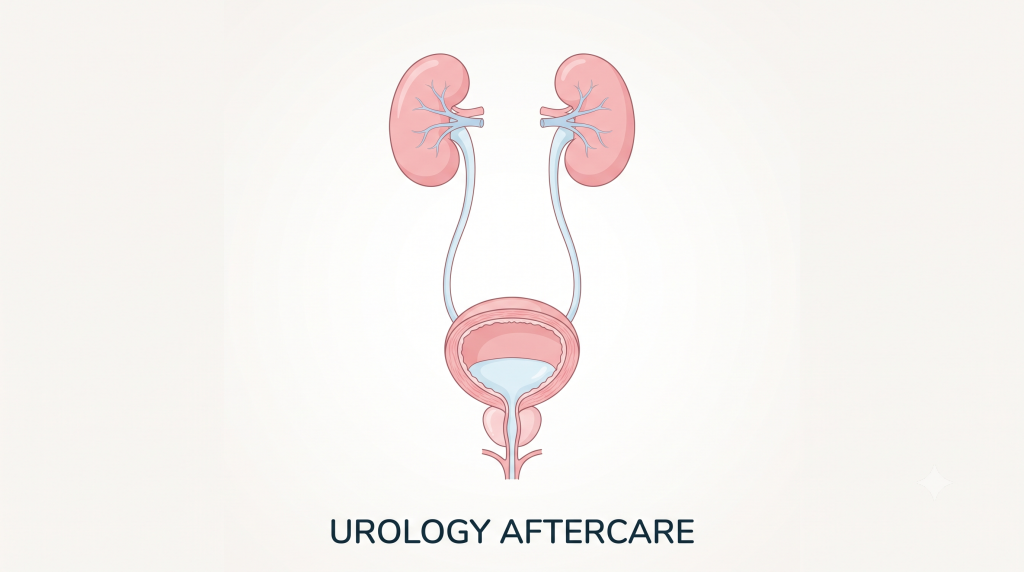
Urology Aftercare Korea: Recovery After Circumcision, Prostate & Men's Health Surgery (2026)
Medical Content Reviewed by MTK Clinical Team | Updated: August 2026
This guide provides aftercare instructions for international patients who have undergone urological procedures at MTK partner clinics in Korea. Select your treatment below for specific recovery guidelines. Always follow your treating urologist's specific instructions — those take priority.
Jump to Your Procedure
Post-Treatment Instructions by Procedure
Tap any section title below to expand or collapse the aftercare instructions.
General General Urological Post-Operative Principles
- Stay well hydrated. Drink at least 2-to-3 liters of water daily unless your surgeon instructs otherwise. Adequate hydration supports kidney function, flushes the urinary system, and reduces infection risk.
- Take all prescribed medications on schedule. Complete the full antibiotic course even if you feel well. Take pain medication as directed — do not combine with alcohol.
- Avoid strenuous physical activity, heavy lifting (over 5 kg/10 lbs), and straining for the period specified by your surgeon — typically 2-to-4 weeks depending on the procedure.
- Avoid alcohol for at least 1-to-2 weeks — alcohol irritates the urinary tract and interacts with medications.
- Monitor your urine output. Some blood-tinged urine is normal after many urological procedures for the first few days. However, bright red blood, large clots, or inability to urinate requires immediate attention.
- If a urinary catheter is placed, keep the drainage bag below bladder level at all times. Keep the catheter site clean. Do not pull or tug on the catheter. Your clinic will schedule catheter removal.
- Avoid sexual activity for the period specified by your surgeon — typically 2-to-4 weeks depending on the procedure.
- Avoid driving while on narcotic pain medications or until you can perform emergency maneuvers comfortably.
Surgical Prostate Procedures (TURP, Laser Prostatectomy)
Recovery Timeline
Catheter removal: 1-to-3 days. Urinary control improvement: 2-to-6 weeks. Return to desk work: 1-to-2 weeks. Full activity: 4-to-6 weeks. Complete healing: 6-to-8 weeks.
- Blood in the urine is normal and may persist intermittently for 2-to-4 weeks after prostate surgery. Urine may appear pink, red, or tea-colored — this is expected. Increase water intake to keep urine flowing and dilute blood content.
- Avoid straining during bowel movements — use a stool softener as prescribed to prevent constipation. Straining increases pressure in the surgical area and can cause bleeding.
- Avoid sitting for prolonged periods — take short walks regularly to promote circulation and prevent blood clots. However, avoid cycling or horseback riding for at least 6-to-8 weeks.
- Avoid heavy lifting and strenuous activity for at least 4-to-6 weeks.
- Temporary urgency, frequency, or mild burning during urination is common as the tissue heals. These symptoms gradually improve over 2-to-6 weeks.
- Retrograde ejaculation (semen entering the bladder instead of exiting) may occur after certain prostate procedures. This is not harmful but is usually permanent. Discuss this with your surgeon before the procedure if fertility is a concern.
- Avoid alcohol, caffeine, and spicy foods for 2-to-4 weeks — these can irritate the bladder and worsen urinary symptoms.
- No sexual activity for at least 4-to-6 weeks or until cleared by your surgeon.
Procedural Kidney Stone Treatment (ESWL, Ureteroscopy, PCNL)
- Drink at least 2.5-to-3 liters of water daily to help flush stone fragments. This is the single most important aftercare instruction for kidney stone patients.
- Strain your urine using the provided collection strainer to capture any passed stone fragments. Save all fragments in the provided specimen container and bring them to your follow-up appointment — laboratory analysis determines stone composition and guides prevention.
- Blood in the urine is normal for several days after stone treatment, especially after ureteroscopy or PCNL. If bleeding is heavy, increase water intake and rest.
- Mild to moderate flank pain, cramping, or discomfort during urination is common as stone fragments pass. Take prescribed pain medication as needed.
- If a ureteral stent was placed, you may experience bladder discomfort, urgency, frequency, and blood in urine until the stent is removed (typically 1-to-2 weeks). These symptoms are caused by the stent irritating the bladder and are not a sign of complication.
- Avoid strenuous activity for 1-to-2 weeks after the procedure. Walking is encouraged.
- Follow dietary recommendations based on your stone type — your surgeon or MTK coordinator can provide specific guidance. Common recommendations include reducing sodium intake, limiting animal protein, and avoiding oxalate-rich foods depending on stone composition.
- Attend all follow-up appointments — imaging (X-ray or CT) may be needed to confirm all stone fragments have passed.
Surgical Circumcision
Recovery Timeline
Dressing changes: daily for 5-to-7 days. Sutures dissolve or removed: 10-to-14 days. Swelling resolves: 2-to-4 weeks. Return to desk work: 2-to-3 days. Sexual activity: 4-to-6 weeks. Full sensitivity normalization: 2-to-3 months.
- Keep the area clean and dry. Change dressings daily or as directed, using prescribed antibiotic ointment. Gently clean with warm water during dressing changes — do not use alcohol or hydrogen peroxide unless instructed.
- Swelling and bruising are normal and may appear significant in the first few days. This typically peaks at day 2-to-3 and gradually resolves over 2-to-4 weeks.
- Wear snug, supportive underwear (briefs rather than boxers) for 1-to-2 weeks. This reduces movement, supports the healing area, and minimizes discomfort.
- Take prescribed pain medication as directed. Acetaminophen is typically effective. Avoid aspirin and NSAIDs unless approved by your surgeon (increased bleeding risk).
- Avoid sexual activity and erection-provoking stimuli for at least 4-to-6 weeks. Nocturnal erections are unavoidable but the suture line is designed to withstand them.
- No bathing, swimming, or hot tubs until incisions are fully healed — typically 2-to-3 weeks. Brief showers are permitted after 48 hours.
- Avoid strenuous exercise and heavy lifting for 2-to-3 weeks.
- Sensitivity changes are normal — the area may be hypersensitive initially, then gradually normalize over 2-to-3 months as the tissue adapts.
Surgical Vasectomy
- Rest for at least 48 hours after the procedure. Apply ice packs wrapped in cloth to the scrotal area for 20 minutes on, 20 minutes off for the first 24-to-48 hours to minimize swelling.
- Wear snug, supportive underwear or a scrotal support for at least 1 week. This significantly reduces discomfort and swelling.
- Mild pain, swelling, and bruising are normal and typically resolve within 1-to-2 weeks. Take prescribed pain medication as needed.
- Avoid heavy lifting, strenuous exercise, and physically demanding work for at least 1 week.
- Sexual activity may resume after approximately 1 week when comfortable — however, you are NOT immediately sterile. Sperm remain in the reproductive tract for approximately 15-to-20 ejaculations or 2-to-3 months. Continue using contraception until a semen analysis confirms zero sperm count.
- Attend the scheduled semen analysis (typically 2-to-3 months post-procedure) — this is the only way to confirm the vasectomy was successful.
- Showering is typically permitted after 24 hours. Avoid bathing, swimming, and hot tubs for at least 1 week.
- Contact the clinic if you notice increasing swelling, fever, persistent heavy bleeding, or a lump larger than a pea at the incision site.
Male Cosmetic Urology Procedures
Cosmetic Penile Girth Enhancement Aftercare (Fat Grafting / Dermal Filler / Dermal Graft)
Recovery Timeline
Initial swelling peaks: 48-to-72 hours. Major swelling subsides: 2-to-3 weeks. Dressing changes: daily for 5-to-7 days. Return to desk work: 3-to-5 days. Sexual activity: 4-to-6 weeks. Final result: 3-to-6 months (fat grafting) or immediately visible (filler/graft).
- Significant swelling and bruising are normal and may appear alarming in the first few days. Swelling typically peaks at 48-to-72 hours and gradually resolves over 2-to-4 weeks. The penis may appear disproportionately swollen during this period — this is expected and not the final result.
- Apply cold compresses to the area for the first 48 hours: 20 minutes on, 20 minutes off. Wrap the compress in cloth — do not apply directly to skin.
- Keep the surgical area clean and dry. Change dressings daily as instructed. Gently clean with warm water and apply prescribed antibiotic ointment. Avoid scented soaps or products.
- Wear snug, supportive underwear (briefs) for at least 2-to-3 weeks. This controls swelling, supports the healing tissue, and reduces discomfort. Avoid loose boxers during recovery.
- No sexual activity, masturbation, or erection-provoking stimuli for at least 4-to-6 weeks. Erections during early healing can stress the surgical site — if nocturnal erections cause significant pain, contact the clinic.
- No baths, swimming, hot tubs, or saunas until fully healed — typically 3-to-4 weeks. Gentle showers are permitted after 48 hours, but avoid directing water forcefully at the surgical site.
- Avoid strenuous exercise, heavy lifting, and cycling for at least 3-to-4 weeks.
- For fat grafting specifically: not all transferred fat survives. Typically 40-to-60% of grafted fat cells establish blood supply and persist permanently. Some volume loss over the first 3-to-6 months is expected — your surgeon accounts for this by initially over-correcting.
- For dermal filler: the filler may feel firm or lumpy initially. Gentle massage may be recommended by your surgeon after the initial healing period to promote even distribution. Do not massage unless instructed.
- Avoid smoking for at least 4 weeks — nicotine severely impairs blood flow and, in fat grafting cases, dramatically reduces fat cell survival rates.
- Avoid alcohol for at least 2 weeks.
- Take prescribed medications (antibiotics, pain relievers, anti-inflammatory drugs) on schedule.
- Temporary numbness or altered sensation is common and typically resolves over weeks to months as nerves regenerate.
Cosmetic Penile Lengthening Surgery (Suspensory Ligament Release)
Recovery Timeline
Initial rest: 1-to-2 weeks. Sutures removed or dissolve: 10-to-14 days. Return to desk work: 5-to-7 days. Stretching/traction device begins: 2-to-4 weeks (per surgeon's instructions). Sexual activity: 6-to-8 weeks. Final result: 3-to-6 months.
- Rest is critical for the first 1-to-2 weeks. Limit activity to essential movements. Sleep on your back with the pelvic area slightly elevated.
- Swelling and bruising in the pubic area and penile shaft are normal and may be extensive. Apply cold compresses for the first 48-to-72 hours.
- Keep the incision site clean and dry. Follow the prescribed wound care protocol — typically daily dressing changes with antibiotic ointment for 7-to-10 days.
- A penile stretching or traction device may be prescribed starting 2-to-4 weeks after surgery. This is a critical component of the recovery protocol — the device prevents the ligament from reattaching in its original position and helps achieve the desired length gain. Follow the wearing schedule exactly as directed by your surgeon.
- No sexual activity or masturbation for at least 6-to-8 weeks. Premature activity can compromise the surgical result.
- Avoid strenuous exercise, heavy lifting, and any activity that places strain on the pelvic area for at least 4-to-6 weeks.
- No smoking for at least 4 weeks — nicotine impairs wound healing and can compromise the surgical outcome.
- The angle of erection may change temporarily or permanently after suspensory ligament release. Discuss this with your surgeon before the procedure.
- Attend all follow-up appointments. Your surgeon needs to monitor healing, assess the result, and adjust the traction protocol if needed.
- Final length gain results become apparent at 3-to-6 months after consistent use of the prescribed traction device.
Cosmetic Glans Enhancement (Glans Penis Enlargement)
Recovery Timeline
Swelling peaks: 48-to-72 hours. Swelling resolves: 1-to-3 weeks. Return to desk work: 2-to-3 days. Sexual activity: 3-to-4 weeks (filler), 4-to-6 weeks (fat grafting). Final result: 2-to-4 weeks (filler), 3-to-6 months (fat grafting).
- Swelling of the glans is expected and may appear significantly enlarged beyond the intended result during the first 1-to-2 weeks. This is temporary — the final shape and size become apparent as swelling resolves.
- Apply cold compresses gently for the first 48 hours. Do not apply pressure directly to the glans — wrap the compress and position it adjacent to the area.
- Keep the area clean. Gently rinse with warm water after urinating. Apply prescribed antibiotic ointment if directed. Avoid scented products.
- Wear snug, supportive underwear for at least 2 weeks to control swelling and reduce friction.
- No sexual activity or masturbation for at least 3-to-4 weeks (dermal filler) or 4-to-6 weeks (fat grafting). The injected or grafted material needs time to stabilize.
- Temporary numbness or reduced sensitivity of the glans is common after the procedure. Sensation typically returns gradually over 2-to-8 weeks.
- For filler-based procedures: the filler may feel firm initially and soften over the first 1-to-2 weeks. Uneven areas may self-correct as the filler settles. If lumps or asymmetry persist beyond 4 weeks, consult your surgeon.
- For fat grafting: expect some volume loss as not all transferred fat cells survive. The final result stabilizes at approximately 3-to-6 months.
- Avoid smoking and alcohol for at least 2 weeks.
- Contact the clinic if you experience persistent numbness beyond 8 weeks, signs of infection, severe asymmetry, or any difficulty urinating.
Critical When to Contact Your Urologist — Warning Signs
- Inability to urinate for more than 6-to-8 hours — may indicate urinary retention requiring catheterization.
- Heavy bleeding with large clots in urine, or bleeding that worsens rather than improves over time.
- Fever above 38.5°C (101.3°F) — may indicate urinary tract infection or wound infection.
- Severe pain not controlled by prescribed medication, especially if sudden in onset.
- Signs of wound infection: increasing redness, warmth, swelling, or foul-smelling discharge at the incision site.
- Persistent nausea or vomiting preventing fluid intake or medication.
- Sudden severe testicular pain or swelling — requires urgent evaluation.
- Leg pain or swelling, chest pain, or shortness of breath — may indicate blood clot. Call 119 immediately.
Frequently Asked Questions
How long is recovery after circumcision in Korea?
Initial wound healing takes approximately 10-to-14 days, during which you will change dressings daily and keep the area clean. Swelling typically peaks at 2-to-3 days and resolves over 2-to-4 weeks. Sexual activity must be avoided for at least 4-to-6 weeks. Full sensitivity normalization takes 2-to-3 months as the tissue adapts. Most patients can return to desk work within 2-to-3 days.
When can I resume normal activities after penile enhancement surgery in Korea?
Desk work can typically resume within 3-to-5 days. Strenuous exercise and heavy lifting should be avoided for 3-to-4 weeks. Sexual activity is restricted for 4-to-6 weeks to allow the grafted or injected material to stabilize. Avoid smoking for at least 4 weeks as nicotine significantly reduces fat graft survival rates.
Aftercare Guides by Specialty
View recovery instructions for other medical specialties:
Medical Disclaimer: This aftercare guide is for informational purposes only and does not replace the specific post-operative instructions provided by your treating urologist. Always follow your doctor's instructions. Contact your clinic immediately or call 119 for any emergency.