
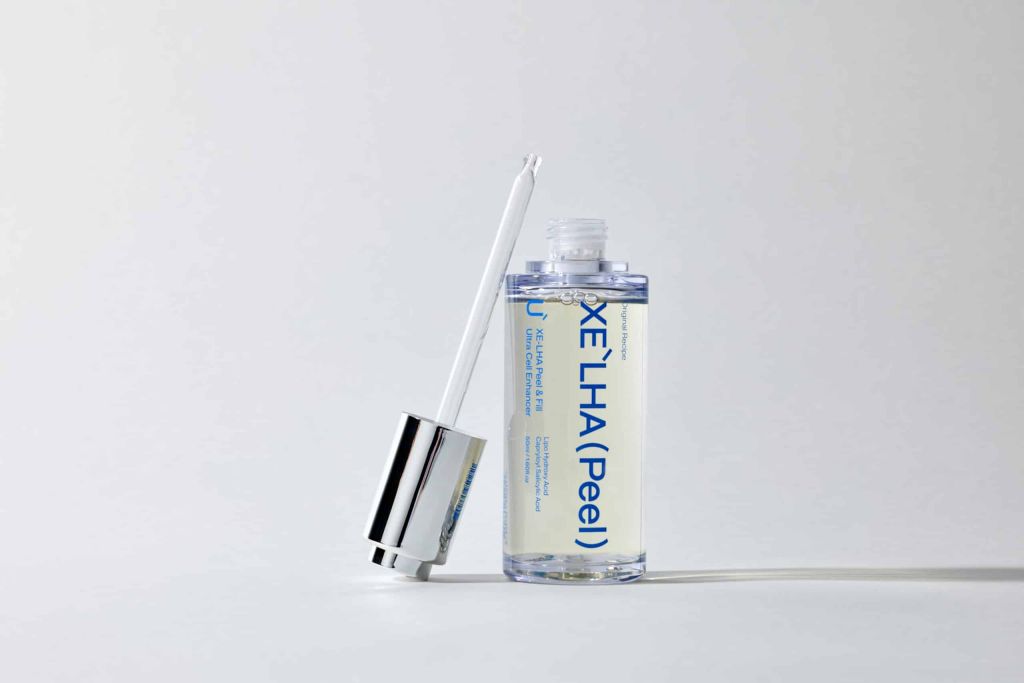
Quick Answer: XE-LHA Peel—marketed in Korea as 쎄라필 and often rendered in English clinic menus as Therapeel—is a Korean professional chemical-peel protocol built around LHA, meaning lipohydroxy acid—not “linoleic hydroxy acid.” In dermatology literature, LHA is a lipophilic derivative of salicylic acid used for controlled superficial exfoliation. XE-LHA combines LHA with proprietary brand technologies and is marketed as a low-irritation peel, but that does not mean zero irritation or that it is automatically suitable for every sensitive-skin condition. [1], [4]
Korea price guide: MTK’s reviewed public Korean clinic listings suggest approximately ₩40,000–₩110,000+ for a standalone XE-LHA Peel session, while enhanced options that add LED, masks, galvanic care, LDM or other skin-care steps can reach roughly ₩50,000–₩150,000+. Prices are references only; confirm VAT, inclusions and the clinic’s final quote.
XE-LHA Peel in Korea at a Glance
- Korean market name: 쎄라필; English clinic menus may render the name as Therapeel.
- Category: professional superficial chemical-peel / skin-care protocol.
- Core ingredient: LHA (lipohydroxy acid), a lipophilic salicylic-acid derivative.
- Brand protocol: XE-LHA Peel Basic followed by XE-LHA Peel Ultra, with finishing care depending on the clinic.
- Common goals: surface smoothness, dullness, comedonal congestion and cosmetic skin-tone refinement.
- Evidence boundary: LHA has peer-reviewed literature; many XE-LHA-specific barrier, microbiome and pigmentation claims come from manufacturer or patent-level data rather than independent clinical trials.
What is XE-LHA Peel?
XE-LHA Peel is a professional Korean peeling system, also marketed domestically as 쎄라필, built around LHA plus the brand’s proprietary technologies, including Youth P-Sol™ and DactorTec™ KIS. The manufacturer’s current protocol presents Basic and Ultra as sequential peel steps, followed by finishing care. [1], [2]
For beginners, the most important distinction is between what is supported by LHA research and what is specific to the XE-LHA formulation. Peer-reviewed studies support LHA as a keratolytic / comedolytic exfoliating ingredient. They do not automatically validate the finished XE-LHA protocol. Claims about XE-LHA’s proprietary microbiome or “Peel & Fill” technologies should therefore be read as brand-specific claims unless independent human clinical evidence is available. [3], [4]
What Does LHA Mean?
LHA stands for lipohydroxy acid. It is also described in dermatology literature as capryloyl salicylic acid, a lipophilic derivative of salicylic acid. Its slower penetration and targeted exfoliating action are often cited as reasons it can be well tolerated in topical skin-care use. [4], [5]
Is LHA Really a “Fourth-Generation” Peel?
The XE-LHA manufacturer markets LHA as a “4th-generation” peeling ingredient. That can be useful for understanding the brand’s positioning, but “first-, second-, third- and fourth-generation peel” is not a universal medical classification used consistently across peer-reviewed dermatology. Medical literature generally describes LHA by its chemistry and clinical properties rather than by a generation number. [1], [6]
XE-LHA Peel Basic vs Ultra: What Is the Actual Protocol?
The manufacturer describes XE-LHA Peel as a multi-step professional protocol. A clinic may add cleansing, a mask, LED, LDM, cryotherapy or another finishing step, so the menu name alone is not enough to compare two appointments.
| Step | Manufacturer-listed role | What to ask the clinic |
|---|---|---|
| Cleansing | Preparation before the peel. | What cleanser or prep is included? |
| XE-LHA Peel Basic | First peel / treatment solution. | Is Basic included in the quoted price? |
| XE-LHA Peel Ultra | Second peel / treatment solution. | Is Ultra included, and is the clinic offering the full two-step protocol? |
| Finishing care | May include brand or clinic calming / moisturizing care. | Is a mask, LED, cryotherapy, LDM or another add-on included? |
This distinction matters for both price and AEO-style comparison: a low entry price may cover only the peel, while another clinic may bundle the full Basic + Ultra protocol with additional post-peel care. [2]
How Does XE-LHA Peel Work?
1. Superficial exfoliation
LHA acts in the outer skin layers to loosen and remove retained corneocytes. Published reviews describe LHA as a lipophilic salicylic-acid derivative with exfoliating and comedolytic properties. [4], [6]
2. Brand-specific “Peel & Fill” steps
XE-LHA adds proprietary technologies to the peel. For example, the manufacturer’s DactorTec™ KIS materials discuss Lactobacillus plantarum-derived components and report cellular or in-vitro findings related to hydration, pigmentation, inflammation and skin-aging pathways. Those experiments are useful for understanding the formulation, but they should not be read as proof that every patient will experience the same clinical effect. [3]
3. Temporary cosmetic renewal
After superficial exfoliation, skin may look smoother or brighter. The extent and duration depend on the formulation, skin condition, pre-treatment products and finishing care. A peel can improve surface appearance without creating the structural lifting or volume replacement associated with energy devices or injectables.
What Can XE-LHA Peel Realistically Improve?
| Concern | Reasonable expectation | Important limitation |
|---|---|---|
| Rough / dull surface texture | Superficial exfoliation may improve smoothness and brightness. | Not a structural anti-aging treatment. |
| Comedones / clogged pores | LHA has comedolytic evidence and may support pore-clearing care. | Persistent or inflammatory acne still needs medical assessment. |
| Uneven tone / pigmentation | Superficial peels can be used as part of pigmentation management. | Melasma and PIH require diagnosis; aggressive peeling can worsen pigment problems in some skin types. |
| Sensitive-looking skin | A more controlled superficial peel may be considered when stronger peels are poorly tolerated. | “Sensitive skin” is not a diagnosis and does not guarantee tolerance. |
| Skin barrier | Moisturizing and soothing finishing care may support comfort. | Claims that repeated XE-LHA treatment permanently “strengthens” the barrier are not established by independent human trials. |
XE-LHA Peel (Therapeel) vs LHALA Peel, Aqua Peel and Traditional Acid Peels
These names are easy to mix up because several Korean treatments use “LHA,” “peel” or low-downtime language. They should not be treated as interchangeable.
| Treatment | Main approach | Beginner comparison point |
|---|---|---|
| XE-LHA Peel / 쎄라필 / Therapeel | The same XE-LHA branded LHA-based professional peel system. | Confirm Basic + Ultra steps and any finishing-care add-ons. |
| LHALA Peel | A separate Korean branded peel protocol that also uses LHA-related positioning. | It is not the same brand or formula as XE-LHA; do not compare prices as if they were identical products. |
| Aqua Peel | Liquid exfoliation plus suction-based pore cleansing; protocol varies by clinic. | More focused on suction / pore cleansing than a chemical-peel-only approach. |
| Salicylic acid peel | Superficial BHA chemical peel. | Has direct acne-peel evidence; concentration and protocol strongly affect irritation and results. |
| Glycolic acid peel | Superficial AHA chemical peel. | Often selected for texture, tone and photodamage; strength and pH matter. |
The available evidence does not support a universal statement that LHA peels are always gentler or more effective than salicylic acid peels. In one small randomized split-face study of comedonal acne, both LHA and salicylic-acid peels reduced lesions, with no significant difference in non-inflammatory lesion reduction; a later systematic review concluded that the evidence is too limited to establish a definitive winner among chemical peels. [5], [6]
For a detailed pore-cleansing guide, see Aqua Peel Complete Beginner’s Guide .
Is XE-LHA Peel Good for Sensitive Skin or Rosacea?
It can be an option for some sensitive-skin patients, but “sensitive” does not mean automatically suitable. LHA has a reputation for controlled superficial exfoliation and good tolerability, and the XE-LHA manufacturer positions the protocol as low irritation. However, chemical peels can still cause stinging, redness, dryness, post-inflammatory pigmentation or barrier irritation. [1], [4], [7]
Active rosacea flare, dermatitis, open skin, infection, recent sunburn, recent procedures or current acne medications can change the risk. Do not treat rosacea or a compromised barrier as a reason to “peel through” irritation. If your main problem is persistent redness, burning or barrier dysfunction, a medical skin assessment may be more useful than automatically booking another peel.
Can XE-LHA Peel Help Acne?
LHA has direct evidence for comedonal acne. A small randomized trial compared LHA with salicylic-acid peels over six sessions and found improvement in both sides of the face. However, the systematic review that included this study rated the overall chemical-peel evidence as limited and could not establish one peel as clearly superior. [5], [6]
That evidence supports LHA as an ingredient; it does not prove that XE-LHA Peel alone treats every type of acne. Inflammatory acne, nodules, cysts, scarring or recurrent breakouts may require prescription treatment rather than repeated cosmetic peeling.
Can XE-LHA Peel Help Pigmentation or Melasma?
Superficial chemical peels are used in dermatology for selected dyschromias and pigmentation concerns. The XE-LHA manufacturer also makes pigmentation-related claims for its formula. However, melasma and post-inflammatory hyperpigmentation can worsen when skin becomes irritated, so “more peeling” is not always better. [1], [8]
If pigmentation is your main concern, ask whether the diagnosis is melasma, post-acne pigmentation, sun damage or another condition, and how the clinic plans to control irritation and sun exposure.
How Is the Procedure Done?
The exact protocol varies, but the manufacturer’s current sequence is cleansing → XE-LHA Peel Basic → XE-LHA Peel Ultra → care . Some clinics bundle a modeling mask, LED, galvanic care, LDM or another soothing step after the peel. [2]
Do not rely on a fixed application time from a general guide. Acid concentration, amount, contact time, method of removal and finishing care should follow the product protocol and your skin response.
Does XE-LHA Peel Hurt?
A superficial peel can feel mild, but stinging, warmth or sensitivity can still occur. The manufacturer markets XE-LHA as low irritation; medical peel guidance also emphasizes that even superficial peels can cause redness, scaling or temporary discomfort depending on the product and patient. [1], [7]
Persistent burning, marked pain or rapidly increasing redness should not be dismissed as proof that the peel is “working.” Tell the provider so the product can be removed and your skin assessed.
How Many XE-LHA Peel Sessions Do I Need?
There is no evidence-based universal XE-LHA course of 4–6 sessions. The best-known LHA peel acne trial used six treatments at two-week intervals, but that was a research protocol using LHA peel concentrations in a small 20-person study— not a validated schedule for the proprietary XE-LHA system. [5]
A single session may be enough if your goal is a temporary cosmetic refresh. If repeated sessions are proposed, ask what outcome will be reassessed, how your skin barrier is responding and why the interval fits the exact formulation.
How Long Do XE-LHA Peel Results Last?
XE-LHA Peel is a surface-renewal treatment, not a permanent structural treatment . Smoothness and brightness may be noticeable soon after a superficial peel, but there is no high-quality evidence establishing a universal “1–2 week” duration for XE-LHA Peel.
Duration depends on the formulation, skin condition, ongoing acne or pigmentation, home exfoliants and sun exposure. Instead of promising a fixed lifespan, compare photographs and symptoms at follow-up and decide whether another peel is appropriate.
How Much Does XE-LHA Peel Cost in Korea?
For a standalone XE-LHA Peel session, MTK’s reviewed public Korean clinic listings suggest approximately ₩40,000–₩110,000+. Enhanced versions that add LED, masks, galvanic care, LDM or other skin-care steps can reach roughly ₩50,000–₩150,000+.
| Clinic-listed option | Approximate reference range | What to compare |
|---|---|---|
| XE-LHA Peel — standalone / Basic + Ultra | ₩40,000–₩110,000+ | Check whether the price includes both Basic and Ultra, a finishing mask and VAT. |
| XE-LHA Peel + mask / LED / calming care | ₩50,000–₩120,000+ | Confirm whether the added care is included or charged separately. |
| XE-LHA Peel + LDM / galvanic / device care | ₩80,000–₩150,000+ | Compare the added device time and treatment scope, not the peel name alone. |
| XE-LHA Peel + laser / injectable package | Not comparable as a standalone peel | Ask for itemized pricing because the additional procedure can drive most of the package cost. |
Source: MTK reference price ranges, compiled and estimated from publicly available clinic pricing and pricing information published on the MTK platform. The reviewed market sample is mainly from Seoul and the greater Seoul area. These are budgeting references, not national averages or guaranteed bookable prices; “+” means higher quotes are possible.
Prices are for reference only. The final treatment plan and price are subject to the quote provided by the clinic you visit after consultation. Please confirm whether VAT and any additional charges are included, including Basic + Ultra, masks, LED, LDM, galvanic care or other add-ons.
How Do I Budget for Multiple Visits?
If a clinic proposes three visits and the confirmed standalone price is ₩50,000–₩100,000 per visit, the simple arithmetic budget is ₩150,000–₩300,000 before separately charged VAT or add-ons. Five visits at the same per-visit range would be ₩250,000–₩500,000. These are budgeting examples, not a recommendation for three or five sessions and not a claim about package discounts.
What Is the Downtime?
XE-LHA is marketed as a low-downtime peel, and many people may return to ordinary activities soon after treatment. However, zero downtime should not be guaranteed. Superficial chemical peels can cause redness, scaling, dryness, stinging or temporary sensitivity, and the reaction depends on skin type, peel depth and aftercare. [7]
If you have an important event or flight, allow flexibility rather than assuming your skin will look completely unchanged the same day.
Are There Any Side Effects?
Possible reactions include redness, dryness, peeling, irritation, post-inflammatory hyperpigmentation, acne flare or contact reaction. Risk increases when skin is already irritated or when multiple exfoliating products and procedures are stacked together. [7], [8]
Contact the treating clinic or a medical professional if you develop persistent burning, blistering, marked swelling, crusting, worsening rash or pigment change that is more than expected after a superficial peel.
Post-Treatment Care Tips
Aftercare should match your actual peel strength and skin response. The safest default is a gentle routine until the skin feels settled.
- Cleanse gently: avoid scrubs, brushes and additional exfoliation while the skin is sensitive.
- Moisturize: use a simple moisturizer as instructed to reduce dryness and support barrier comfort.
- Protect from sun: daily sunscreen is important after chemical peeling because irritated or healing skin can be more vulnerable to pigment change. [7]
- Review active products: tell the clinic about retinoids, benzoyl peroxide, AHA/BHA products and prescription acne treatment before the peel. [8]
- Do not pick flaking skin: rubbing or scratching treated skin can increase irritation and infection risk.
Can XE-LHA Peel Be Combined With Other Treatments?
It can appear in packages with Aqua Peel, LDM, lasers, Rejuran, Juvelook or other procedures, but there is no universal rule that chemical exfoliation makes injections or energy devices work better . The useful question is whether exfoliating the skin before another procedure adds benefit or simply increases irritation.
Same-day treatment or spacing should be decided for the exact combination, skin condition and medication history. Do not rely on a universal “24-hour” or “one-week” interval from a generic article.
For related MTK guides, see Aqua Peel Complete Beginner’s Guide and Juvelook Complete Beginner’s Guide .
Is XE-LHA Peel FDA-approved?
The manufacturer’s website lists the U.S. regulatory status as “REGISTERED.” That should not be rewritten as “FDA-approved.” FDA registration, clearance and approval are different regulatory concepts. If a clinic makes a U.S. approval claim, ask which exact product and FDA record it refers to. [1], [9]
Final Tips for Beginners
Before booking, confirm the exact product, Basic + Ultra steps, other add-ons, total price, current skin condition, active products and aftercare . The most useful XE-LHA consultation is not “Is this the gentlest peel?” but “Why does this formulation fit my current skin better than the alternatives?”
Frequently Asked Questions
What does LHA stand for in XE-LHA Peel?
LHA stands for lipohydroxy acid, not linoleic hydroxy acid. In dermatology literature it is described as a lipophilic derivative of salicylic acid, also known as capryloyl salicylic acid. [4]
Is XE-LHA Peel the same as Therapeel or LHALA Peel?
XE-LHA Peel is marketed in Korea as 쎄라필, commonly rendered as Therapeel in English clinic menus. LHALA Peel is a separate Korean branded peel and should not be treated as the same formula or protocol.
How much does XE-LHA Peel cost in Korea?
MTK’s reviewed public Korean clinic listings suggest about ₩40,000–₩110,000+ for a standalone XE-LHA Peel session and about ₩50,000–₩150,000+ when additional LED, masks, galvanic care, LDM or other skin-care steps are included. Prices are references only; the clinic confirms the final quote.
Is XE-LHA Peel good for sensitive skin?
It may be considered for some sensitive-skin patients, and LHA is associated with controlled superficial exfoliation, but sensitive skin is not an automatic indication. Active dermatitis, rosacea flare, infection or an already irritated barrier may increase the chance of stinging or redness. [4], [7]
Can XE-LHA Peel help acne?
LHA has evidence for comedonal acne, but the evidence does not prove that proprietary XE-LHA Peel alone treats every type of acne. Inflammatory acne, cysts, scarring or persistent breakouts may require medical treatment. [5], [6]
Is XE-LHA Peel better than salicylic acid or glycolic acid peels?
There is no universal winner. A small randomized study found improvement with both LHA and salicylic-acid peels, while a systematic review concluded that current evidence is too limited to establish one chemical peel as definitively superior across patients. [5], [6]
How many XE-LHA Peel sessions do I need?
There is no evidence-based universal XE-LHA course. A research study of LHA peels used six sessions at two-week intervals, but that study protocol should not be converted into a standard schedule for the proprietary XE-LHA system. [5]
How long do XE-LHA Peel results last?
The effects are temporary and mainly involve surface renewal. There is no high-quality evidence establishing one universal 1–2 week duration for every XE-LHA protocol. Duration depends on skin condition, formulation, home care and ongoing acne or pigmentation.
Does XE-LHA Peel have downtime?
It is usually positioned as a low-downtime superficial peel, but redness, dryness, scaling, stinging or temporary sensitivity can still occur. Zero downtime should not be guaranteed. [7]
Is XE-LHA Peel FDA-approved?
The manufacturer website lists the U.S. regulatory status as registered. FDA registration is not the same as FDA approval or clearance, so a clinic should identify the exact product and regulatory record behind any U.S. approval claim. [1], [9]
Product and Medical References
Manufacturer sources below are used for XE-LHA product identity, protocol and brand-specific technology statements— not as independent proof of clinical superiority. Peer-reviewed LHA literature supports the ingredient-level discussion. General chemical-peel guidance is kept separate from XE-LHA-specific claims.
- XE-LHA official brand site: product positioning, product line and listed regulatory status.
- XE-LHA official product information: Peel Basic, Peel Ultra sequence and manufacturer FAQ.
- XE-LHA official technology information: DactorTec™ KIS patent and in-vitro / cellular-level findings.
- Zeichner JA. The Use of Lipohydroxy Acid in Skin Care and Acne Treatment. J Clin Aesthet Dermatol. 2016;9(11):40–43. PMID 28210389.
- Levesque A, et al. Randomized trial comparing a lipophilic hydroxy acid derivative of salicylic acid with a salicylic acid peel in subjects with comedonal acne. J Cosmet Dermatol. 2011;10(3):174–178. PMID 21896127.
- Chen X, et al. Chemical peels for acne vulgaris: a systematic review of randomised controlled trials. BMJ Open. 2018;8:e019607. PMID 29705755.
- American Academy of Dermatology: chemical peel recovery, aftercare and possible side effects.
- American Academy of Dermatology: chemical peel consultation and preparation.
- U.S. FDA: registration, clearance and approval are distinct regulatory concepts.
Medical disclaimer: This guide provides general information, not a diagnosis or individual treatment recommendation. XE-LHA Peel is a branded professional peel and protocols can vary by clinic. Suitability, peel strength, contact time, combination timing and aftercare should be determined after reviewing your skin condition, medications and treatment history.