
Editorially Reviewed by MTK Editorial Team | September 15, 2026
Quick Answer: LDM (Local Dynamic Micromassage) is a non-invasive multi-frequency ultrasound treatment, not a laser or HIFU lifting treatment. In Korea, it is commonly offered for low-downtime skin conditioning, redness or acne-related care, hydration and recovery-oriented support. Based on current publicly listed Korean clinic prices reviewed in September 2026, promotional LDM sessions can start around ₩20,000–₩60,000, while many standard-to-enhanced standalone sessions fall around ₩60,000–₩150,000. Premium, specialist-clinic or longer full-price programs can reach roughly ₩150,000–₩300,000+. Evidence for specific benefits remains promising but limited and indication-dependent.
LDM in Korea at a glance
- What it is: LDM (Local Dynamic Micromassage) is a multi-frequency ultrasound skin treatment, not a laser. In Korea it is also commonly marketed as an LDM facial or “water drop lifting” (물방울리프팅).
- Why people consider it: acne care, redness/rosacea support, sensitive-skin conditioning, hydration, skin-barrier support and low-downtime aesthetic maintenance.
- Evidence level: promising but still limited for several uses; many published studies are small, retrospective or pilot studies.
- Typical LDM price in Korea: public clinic pricing currently spans roughly ₩20,000–₩300,000+ depending on promotion, clinic positioning, session type and inclusions. A practical market split is promotional ₩20,000–₩60,000, standard ₩60,000–₩100,000, mid-range/enhanced ₩100,000–₩150,000, and premium/specialist ₩150,000–₩300,000+.
- Downtime: usually limited, but temporary redness or sensitivity can occur and suitability should be assessed clinically.
- How often: there is no universal schedule. Frequency depends on the treatment goal, skin condition, device protocol and whether LDM is being used alone or around another procedure.
- Booking: MTK can confirm current LDM availability, session length, conditions and the clinic's latest official quote.
Booking note: If you are considering LDM treatment in Korea, MTK can help you compare participating dermatology and aesthetic clinics, confirm the current device/session details and official price before your visit, and check available language assistance for your booking.
How MTK Reviews This Guide
- Medical evidence: clinical claims are checked against peer-reviewed medical literature.
- Device facts: LDM identity, frequency configurations and manufacturer-described applications are checked against official Wellcomet documentation.
- Clinic verification: all hospitals and clinics available through MTK must be registered as a Registered Foreign Patient Attraction Institution in Korea before they can be listed on the platform.
- Clinic & price information: treatment availability and market price references are reviewed separately from medical evidence, using current public clinic price menus, clinic-provided information and MTK platform availability data.
- International-patient support: MTK can reconfirm clinic availability, current official pricing, booking conditions and language assistance before a visit.
What Is LDM Treatment?
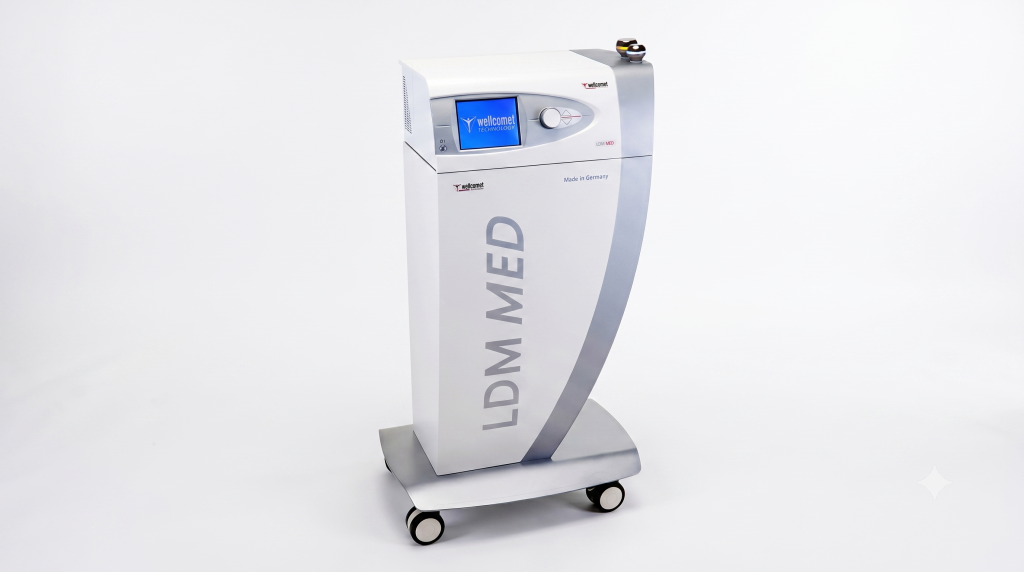
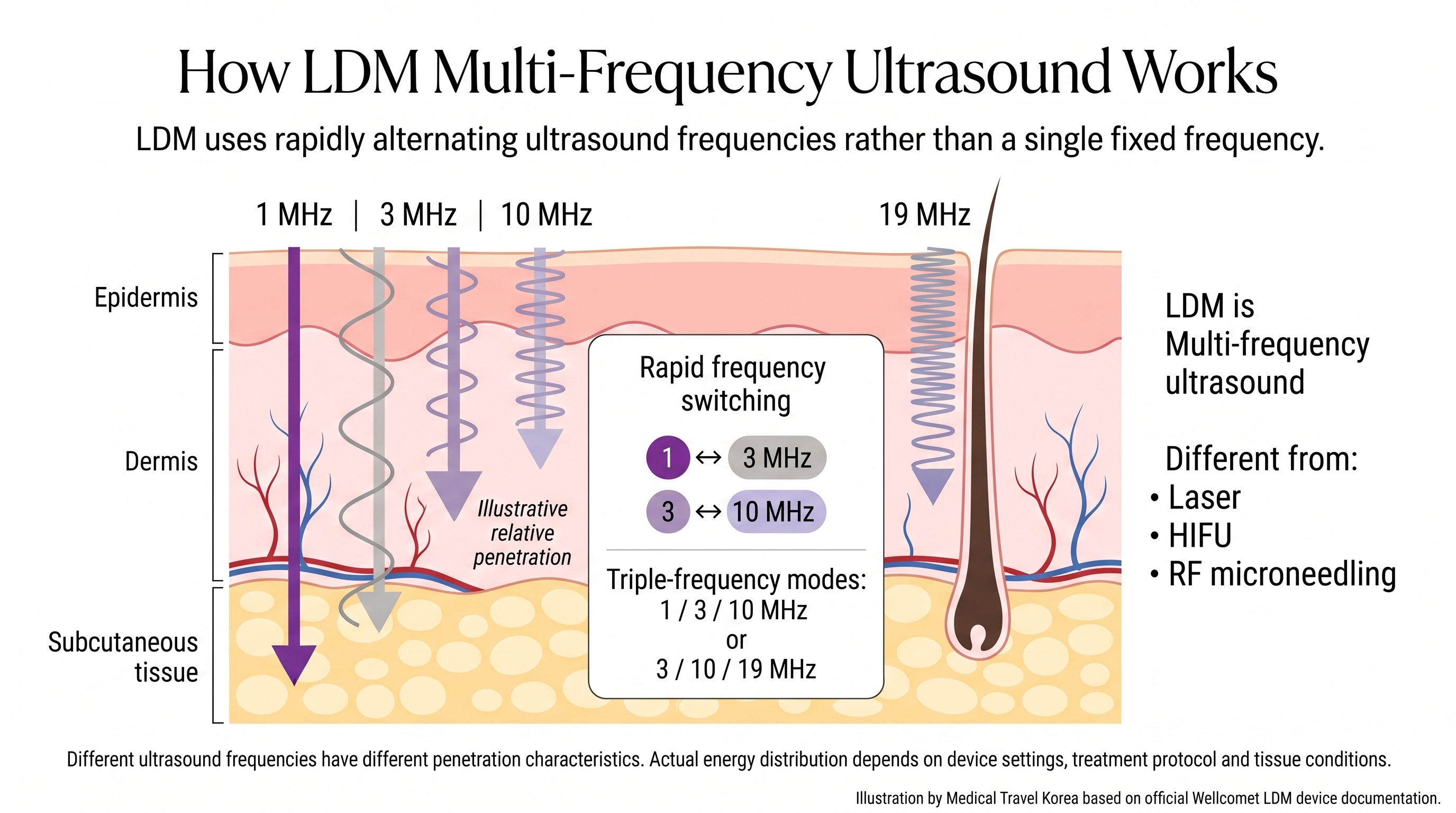
Local Dynamic Micromassage (LDM) is Wellcomet’s multi-frequency ultrasound technology. Wellcomet’s official product documentation includes systems such as LDM® MED, which uses dual-frequency ultrasound programs including 1/3 MHz and 3/10 MHz configurations. LDM rapidly alternates ultrasound frequencies during treatment and should not be confused with HIFU, radiofrequency treatment, microneedling or laser therapy.
In Korean clinics, it may also be marketed as an LDM facial, LDM skin treatment, “water drop lifting,” or 물방울리프팅.
Official Wellcomet documentation describes dual-frequency combinations such as 1/3 MHz and 3/10 MHz, while newer triple-frequency modes may use 1/3/10 MHz or 3/10/19 MHz. These are device facts; clinical outcomes are evaluated separately using peer-reviewed medical literature.
What Is “Water Drop Lifting” in Korea?
“Water drop lifting” (물방울리프팅) is a Korean marketing term, not a separate technology. It is commonly used for LDM-related treatments, but it does not mean that LDM is the same as HIFU or that it produces the same type of structural lifting. When a clinic uses this name, check the actual device, session duration and treatment protocol rather than relying on the marketing term alone.
How Does LDM Work?
Technology distinction: LDM uses ultrasound rather than laser or radiofrequency (RF). This matters when comparing it with treatments such as Potenza, which uses RF microneedling, or with HIFU devices designed for deeper focused ultrasound treatment.
Some consumers also search for “LDM collagen” treatments. Claims about collagen remodeling should be interpreted cautiously: LDM uses multi-frequency ultrasound, but a predictable collagen-building effect should not be assumed from marketing language alone.
The safest way to explain the mechanism is to separate established device facts from proposed biological effects.
LDM uses rapidly changing ultrasound frequencies. Wellcomet describes dual and triple LDM waves that alternate between different frequencies, with frequency combinations selected according to device and treatment mode.
Laboratory and clinical literature on ultrasound discusses mechanical pressure effects, tissue permeability, matrix metalloproteinase signaling, inflammatory pathways, and skin-barrier behavior. These mechanisms can help explain why ultrasound has been investigated for inflammatory and regenerative applications, but they should not be presented as proof that every LDM session will produce a specific cosmetic result.
Which LDM Device Is Used in Korea? LDM MED vs LDM Triple 19
LDM is widely used in Korean clinics, but it is not a Korean-made device. LDM is a trademarked ultrasound technology associated with Germany-based Wellcomet GmbH. Korean dermatology and aesthetic clinics may use different Wellcomet LDM systems, including LDM MED and newer LDM Triple / LDM Triple 19 platforms.
LDM Triple 19 expands the available ultrasound frequencies to include 1, 3, 10 and 19 MHz, with triple-frequency modes such as 1/3/10 MHz or 3/10/19 MHz depending on the system and program. The device name alone does not tell you which mode, treatment duration or clinical goal a clinic will use.
If you searched for “LDM device Korea,” “Korean LDM device,” or “LDM Triple 19 price,” distinguish the machine from the treatment session. The consumer prices in this guide refer to clinic treatment sessions, not the purchase price of an LDM machine. For a fair clinic comparison, confirm the exact device model, whether Triple 19 is being used, the session duration, the selected mode and what is included in the quoted price.
What Does the Clinical Evidence Actually Show?
There are two evidence categories worth separating: direct LDM studies, where the paper explicitly identifies LDM technology, and broader dual-frequency ultrasound studies, which support the modality but do not necessarily test a Wellcomet LDM device. This distinction matters for medical accuracy.
- Direct LDM evidence: small clinical studies have reported improvement in acne severity and postoperative swelling/bruising.
- Related ultrasound evidence: dual-frequency ultrasound studies have reported improvements in erythema, TEWL and selected rosacea-associated symptoms, but not every study used a Wellcomet LDM device.
- What this does not prove: current evidence does not establish that LDM works for every skin concern, every device mode or every combination treatment.
| Clinical area | Study type | What was studied | What it supports | Important limitation |
|---|---|---|---|---|
| Acne | Retrospective two-center study, 22 patients | Triple-frequency LDM, 1/3/10 or 3/10/19 MHz | Acne severity improved in blinded photographic assessments | Small, retrospective; Wellcomet-affiliated author |
| Post-rhinoseptoplasty edema / bruising | Retrospective multicenter blinded comparison, 48 patients | Dual-frequency LDM vs conventional ice packs | Shorter reported duration of edema and ecchymosis in the LDM group | Paper describes retrospective design; Wellcomet scientific-department author |
| Refractory rosacea | Retrospective study, 42 patients | Dual-frequency ultrasound | Improvement in erythema, TEWL and patient-reported symptoms | Modality-level evidence; not enough to generalize to every LDM protocol |
| Rosacea / acne-associated erythema and hydration | Prospective pilot study, 26 completers | 1/3 MHz dual-frequency ultrasound using SONO STYLER | Improved erythema index and TEWL; no serious adverse effects reported | Not an LDM-branded Wellcomet device; no control group; small sample; study was sponsored by WEYERGANS |
Bottom line: LDM has real peer-reviewed clinical literature behind it, but the evidence base is not large enough to justify claims such as “proven for all skin problems,” “guaranteed barrier repair,” or a treatment with zero risk. The strongest wording for most consumer-facing claims is has been studied for, may help, or clinical studies have reported improvement.
What Results Can You Realistically Expect From LDM?
For most aesthetic use cases, LDM is better understood as a skin-conditioning or recovery-oriented treatment than as a dramatic one-session lifting procedure. Depending on the indication and protocol, patients may be seeking improvement in hydration-related measures, redness, comfort, post-procedure swelling or overall skin condition. The magnitude and duration of improvement are not standardized across all LDM uses.
For travelers comparing LDM before and after results online, photographs can be difficult to interpret because lighting, concurrent treatments, skincare, swelling and camera settings can all change appearance. A more useful question is whether the clinic can explain the treatment goal, device mode, session duration and what change is realistic from the number of sessions you can complete.
There is no evidence-based universal rule for how long “LDM results” last. Duration depends on the indication, protocol, number of sessions, underlying skin condition and whether other treatments were performed at the same time. Avoid claims that promise a fixed number of months for every patient.
What Can LDM Be Used For?
International patients researching skin rejuvenation in Korea may encounter LDM for acne-related care, redness, sensitive or irritated skin, postoperative swelling, hydration and skin-barrier support. These uses do not all have the same evidence strength, so each should be considered separately.
1. Acne and Inflammatory Skin
A 2025 retrospective two-center study evaluated triple-frequency LDM in 22 patients with mild-to-severe acne. The paper reported improvement in acne severity based on photographs assessed by nine independent dermatologists.
Evidence strength: encouraging but limited. The study was small and retrospective, and one author was affiliated with Wellcomet. For patients searching LDM acne treatment in Korea, the most accurate framing is that LDM has been studied as an adjunctive acne-care approach, not as a universally proven acne cure.
2. Redness and Rosacea-Associated Symptoms
A 2018 retrospective study of 42 patients with refractory rosacea reported improvements in erythema, transepidermal water loss (TEWL) and patient-reported symptoms after dual-frequency ultrasound treatment. A separate 2021 prospective pilot study from an Asan Medical Center dermatology team reported improvements in erythema index and TEWL after four weekly dual-frequency ultrasound sessions.
Evidence strength: limited and partly modality-level. The 2021 study used a different dual-frequency ultrasound device rather than a Wellcomet-branded LDM system, so it should not be treated as direct proof for every LDM device or protocol. For patients, this means LDM may be considered for redness or rosacea-associated symptoms after clinical assessment, but it should not be presented as a guaranteed or first-line cure.
3. Sensitive or Irritated Skin
LDM is often marketed in Korea for sensitive, irritated or recently treated skin because it is a low-downtime ultrasound treatment. However, “sensitive skin” is not one diagnosis, and suitability depends on the cause of irritation, active skin disease and recent procedures.
Evidence strength: indirect and indication-dependent. The safest patient-facing interpretation is that LDM may be considered as a skin-conditioning or recovery adjunct after clinician assessment—not that it is automatically safe or effective for every sensitive-skin condition.
4. Post-Procedure Swelling and Bruising
A 2024 paper evaluated LDM after rhinoseptoplasty, comparing 24 LDM-treated patients with 24 patients treated with conventional ice packs. The authors reported shorter durations of postoperative edema and bruising in the LDM group.
Evidence strength: directly relevant to LDM but still limited. The paper describes a retrospective design and includes an author from Wellcomet’s scientific and development department. For patients, this supports discussing LDM as a possible postoperative recovery adjunct in selected situations; it does not mean LDM should automatically be performed after every laser, injectable, RF treatment, peel or surgery.
5. Skin Hydration and Barrier Support
Small dual-frequency ultrasound studies have reported improvements in hydration-related and barrier-related measurements, including erythema index and TEWL, particularly in patients with rosacea- or acne-associated facial erythema.
Evidence strength: preliminary. “Skin barrier support” is a reasonable educational description when tied to the available evidence, but claims such as “permanently strengthens the barrier” or “repairs all compromised skin” go beyond what current studies establish.
LDM vs HIFU vs Ultherapy vs Thermage
This is one of the most important distinctions for first-time patients. LDM is often grouped with energy-based treatments, but its role is different from structural lifting devices.
| Treatment | Main energy | Typical clinical goal | How it differs from LDM |
|---|---|---|---|
| LDM | Rapidly alternating multi-frequency ultrasound | Skin conditioning, inflammatory-skin or recovery-oriented applications depending on protocol | Does not use focused thermal coagulation points for structural lifting |
| Ultherapy / MFU-V | Microfocused ultrasound with visualization | Non-surgical lifting and tightening at selected tissue depths | Focused thermal treatment rather than rapidly alternating multi-frequency ultrasound |
| HIFU / Shurink | High-intensity focused ultrasound | Facial lifting / tightening | Concentrates ultrasound energy at defined depths |
| Thermage FLX | Monopolar radiofrequency | Skin tightening and collagen remodeling | Uses RF, not ultrasound |
| Potenza | RF microneedling | Acne scars, pores, texture and selected acne protocols | Uses needles to deliver RF beneath the surface |
For a deeper comparison of focused-ultrasound lifting systems, see MTK's Ultherapy vs. Shurink in Korea guide.
LDM vs Rejuran, Potenza, Skin Boosters and Aqua Peel
These treatments are often searched together in Korea, but they solve different problems. The useful comparison is not “which is best?” but which treatment matches your main concern, downtime tolerance and willingness to have injections or microneedling.
| Treatment | Typical reason people consider it | Invasiveness / downtime | How it differs from LDM |
|---|---|---|---|
| LDM | Skin conditioning, redness/inflammatory-skin support, hydration or recovery-oriented care depending on protocol | Non-invasive; usually low downtime | Multi-frequency ultrasound; generally subtler and less invasive than injectable or RF-microneedling treatments |
| Rejuran | Injectable skin-quality treatment | Injections; temporary bumps, swelling or bruising can occur | Rejuran is an injectable treatment, while LDM is non-invasive ultrasound |
| Potenza / RF microneedling | Acne scars, pores, texture and selected acne protocols | Microneedling + RF; more downtime than LDM | Creates controlled needle/RF injury for remodeling; LDM does not |
| Skin boosters | Hydration and skin-quality goals depending on the injected product | Injection-based | Product is injected into the skin; LDM does not inject material |
| Aqua Peel / hydro-dermabrasion | Surface cleansing, exfoliation and cosmetic refresh | Non-invasive; generally low downtime | Primarily targets surface cleansing/exfoliation rather than using multi-frequency ultrasound |
Decision shortcut: If your priority is minimal downtime and non-invasive skin conditioning, LDM may be worth discussing. If your main concern is acne scarring, structural laxity, pigment or an injectable skin-quality goal, another treatment may be more directly aligned with that objective.
Does LDM Hurt?
LDM is generally described as a comfortable, non-invasive treatment. Published LDM and dual-frequency ultrasound studies often report good tolerability, and some study participants reported no treatment-related pain or serious adverse events.
That is different from saying LDM causes an absolute pain-free guarantee for every patient. Sensation varies by device mode, intensity, treated area and individual sensitivity. Patients may notice warmth, pressure or vibration during treatment.
LDM Downtime and Side Effects
Tell the clinic if you are also planning laser, injectable, HIFU or radiofrequency (RF) treatment so the clinician can decide whether same-day sequencing is appropriate.
For many patients, downtime is minimal. This is one reason LDM is frequently offered in Korean clinics as a standalone maintenance treatment or as an adjunct around other aesthetic care. However, no medical procedure should be described as having absolute claims that side effects never occur or that risk is zero.
Published studies have generally reported favorable tolerability, but study populations are limited. Depending on the patient and clinical context, temporary warmth, redness, sensitivity or changes related to the underlying skin condition may occur.
Tell the clinic about implanted electronic or medical devices, current skin disease or infection, recent procedures, medications, pregnancy, major medical conditions, and any prior reaction to energy-based treatments. The treating clinician should determine whether LDM is appropriate for you and which settings are suitable.
How Many LDM Sessions Do You Need?
There is no evidence-based universal number that applies to every patient. Published protocols differ by indication. For example, rosacea and erythema studies have used weekly or initially more frequent sessions over several weeks, while acne studies have used multi-session courses with follow-up.
For a traveler visiting Korea, the practical question is not “Do I need exactly 6 or 10 sessions?” but:
- What problem are you treating?
- Is LDM being used as a standalone treatment or recovery adjunct?
- Which LDM device and frequency mode is the clinic using?
- How much treatment time is included per session?
- Can the planned course realistically fit your travel schedule?
A single session may be reasonable for a traveler seeking a low-commitment treatment, while medical or inflammatory indications may require a structured multi-session plan. The clinic should explain what outcome is realistic from the number of sessions you can actually complete.
How Much Does LDM Cost in Korea? 2026 Price Guide
There is no single “standard Korean price” for LDM. Current public clinic menus reviewed in September 2026 show a wide spread—from short promotional sessions around ₩20,000 to specialist-clinic or longer full-price programs around ₩200,000–₩300,000. A more useful way to compare LDM is by price tier + treatment specification, not by session minutes alone.
What price range should you expect for LDM in Korea?
| Market tier | Typical current range | What you may see in this tier |
|---|---|---|
| Promotional / entry price | about ₩20,000–₩60,000 | First-visit offers, short sessions, monthly events, selected-branch offers, or LDM sold as a lower-cost add-on. |
| Standard aesthetic-clinic price | about ₩60,000–₩100,000 | Common standalone LDM menus for hydration, calming, redness, acne-related care or basic water-drop lifting. |
| Mid-range / enhanced session | about ₩100,000–₩150,000 | Longer sessions, premium modes, water-drop lifting, or LDM with LED, modeling packs or additional skin-care steps. |
| Premium / specialist-clinic price | about ₩150,000–₩300,000+ | Higher-priced dermatology or premium clinics, longer/full-price programs, or more comprehensive treatment protocols. |
These are directional market price bands based on publicly listed Korean clinic prices reviewed in September 2026, not a nationwide regulated fee schedule. They are intended to help travelers understand why two clinics can advertise very different LDM prices for treatments that appear to have the same name.
Source type: current public clinic price menus and public treatment listings reviewed in September 2026. Observed examples include: short promotional LDM around ₩19,900–₩55,000; standard/basic menus around ₩66,000–₩100,000; enhanced or water-drop lifting programs around ₩110,000–₩149,000; and higher-priced specialist/full-price programs around ₩158,000–₩300,000. Scope: market guidance only, not a statistically representative national average.
Why are some LDM prices in Korea so cheap?
Very low LDM prices can be real. Korea's aesthetic market frequently uses first-visit promotions, monthly events, short-session menus, selected-branch offers and add-on pricing. A ₩20,000–₩50,000 listing therefore does not automatically mean the treatment is fake or low quality—but it may not be directly comparable with a longer standalone session or a specialist-clinic program.
- Promotion conditions: Is the price limited to new patients, a specific month, weekday or branch?
- Session duration: Is it a short 6-minute session, a 12-minute treatment, a 20-minute water-drop lifting program or another protocol?
- Device / mode: Which Wellcomet LDM system and program are being used?
- VAT: Is Korea's 10% VAT included in the displayed price?
- Inclusions: Are LED care, modeling masks, hydration care or other steps included?
- Standalone vs combination: Does the price include another laser, RF, injectable or skin-care procedure?
What is a realistic “normal” LDM price in Korea?
If you exclude the cheapest short promotional offers and the highest specialist-clinic pricing, roughly ₩60,000–₩150,000 is a practical current comparison range for many standalone or enhanced LDM sessions in Korea. This is not a fixed national average. A clinic may reasonably fall below or above that range depending on its positioning, session design, mode and included care.
Does a higher LDM price mean a better result?
No—not by itself. Public clinic menus show that price does not rise in a simple linear relationship with treatment minutes. Clinic positioning, protocol, mode, consultation model, package design and included aftercare can all affect price. A more expensive LDM session may include more time or care, but price alone does not prove better clinical outcomes.
What to compare besides price
- Device identity: Ask whether the clinic is using a genuine Wellcomet LDM system or another dual-frequency ultrasound platform.
- Session duration: A short promotional add-on and a longer standalone session should not be treated as the same product.
- Mode / frequency: The clinic should be able to explain the selected program rather than simply saying “LDM lifting.”
- Who evaluates your skin: Especially important if you have active acne, rosacea, dermatitis, or a history of treatment reactions.
- Combination plan: Confirm whether LDM has a defined role in your plan or is simply being added as an upsell.
How Often Can LDM Be Scheduled?
There is no universal interval between LDM sessions. Published protocols vary by indication, and clinic schedules may range from relatively frequent short courses to occasional maintenance visits. The appropriate spacing depends on the treatment goal, current skin condition, device mode, session duration and whether LDM is being used around another procedure. A package should not be chosen solely because more frequent treatment is marketed as better.
Can LDM Be Combined With Rejuran, Laser, Potenza or Other Treatments?
Short answer: Yes, LDM can be used in combination plans, but for most pairings there is limited direct evidence that LDM improves the primary treatment's final result. In practice it is better described as a possible skin-conditioning or recovery adjunct unless stronger comparative evidence exists.
Popular LDM Combination Treatments in Korea
| Combination | Why clinics may combine them | Evidence position |
|---|---|---|
| LDM + Pico Toning / Laser | Laser addresses pigment or texture concerns; LDM may be added as low-downtime skin-conditioning or recovery care. | Direct evidence that LDM improves the final laser result is limited. |
| LDM + Rejuran / Skin Booster | Combines an injectable skin-quality treatment with non-invasive ultrasound care. | There is not strong direct evidence that LDM increases the final Rejuran or skin-booster effect. |
| LDM + Exosome Care | Often positioned as post-procedure skin conditioning. | Superiority of the combination itself is not well established. |
| LDM + Peel / Lhala Peel | The peel targets surface texture or pigmentation concerns, while LDM may be used as follow-up skin-conditioning care. | Direct evidence that the combination is better than the peel alone is limited. |
| LDM + Ultherapy / HIFU | Focused ultrasound targets structural lifting, while LDM may be added for skin-conditioning or recovery-oriented care. | Different treatment goals. Do not interpret LDM as increasing the lifting power of Ultherapy or HIFU. |
| LDM + Potenza / RF Microneedling | RF microneedling targets acne scars, pores and texture; LDM may be scheduled as supportive recovery care depending on skin condition. | Timing should be clinician-directed, and direct combination evidence is limited. |
| LDM + Injection Lipolysis | LDM was used before and after fat-dissolving injections in a randomized contralateral pilot study. | Direct LDM combination evidence exists, but the study included only seven healthy women and one author was the managing partner of Wellcomet. |
Which LDM combinations are actually supported by direct clinical evidence?
The clearest direct combination study identified for this guide is a 2015 randomized, single-center pilot study of injection lipolysis with versus without LDM. Seven women served as their own contralateral controls: one side received injection lipolysis alone, while the opposite side received injection lipolysis plus LDM. The study reported greater measured volume reduction and lower pain scores on the LDM-treated side. Because the study was extremely small and involved a Wellcomet-affiliated author, it should be treated as preliminary evidence rather than proof that LDM improves all injectable treatments.
Clinical reference: Tausch & Kruglikov, Journal of Clinical and Aesthetic Dermatology, 2015.
Not sure whether to add LDM to another treatment?
MTK can help international patients confirm which participating clinics currently offer the combination you are considering, the exact LDM session duration, whether treatments are performed on the same day or on separate visits, the total package price, and whether the clinic recommends LDM for your specific treatment plan.
Compare Skin Clinics with MTKIf you are building a broader Korean skincare plan, MTK's Medical Tourism Korea: The Skin Care Advantage explains how common device and injectable categories differ.
Timing should depend on the primary procedure, skin integrity, infection risk, swelling, device instructions and the treating clinician's protocol. This is especially important after ablative lasers, aggressive peels, RF microneedling, injectables or surgery. A combination appearing on a clinic menu does not mean the same sequence is appropriate for every patient.
Who May Consider LDM?
LDM may be worth discussing with a clinician if you are looking for a relatively low-downtime ultrasound treatment and your goals involve skin conditioning, redness or inflammatory-skin support, acne management, or recovery around another procedure. The best-supported use depends on your actual diagnosis and the protocol being used.
When LDM may not be the main treatment you need
- Structural sagging: If your primary goal is deeper facial lifting, HIFU, Ultherapy, RF or surgery may be more directly aligned with that goal.
- Acne scars: Texture and atrophic scarring often require treatments such as RF microneedling, fractional laser, subcision or combination therapy rather than LDM alone.
- Melasma or focal pigmentation: LDM is not a substitute for diagnosis and pigment-specific treatment planning.
- Active dermatologic disease: Rosacea, eczema, dermatitis and inflammatory acne should be assessed medically rather than treated as generic “sensitive skin.”
How to Choose an LDM Clinic in Korea
Because LDM is widely available, choosing a clinic should be less about finding the cheapest “LDM facial” and more about verifying what you are actually receiving.
- Confirm the exact device. “LDM” is a trademarked technology name, while some clinics and platforms may use the term loosely for other ultrasound care.
- Ask what problem the clinic is treating. The answer should be more specific than “glow” or “detox.”
- Ask how long the treatment lasts and which mode is used.
- For acne, rosacea or dermatitis, prioritize medical evaluation. Cosmetic maintenance and inflammatory skin disease are not the same clinical problem.
- Get the full price before arrival. Confirm VAT, masks, LED care, combination add-ons and package requirements.
Compare verified skin clinics in Korea
For a broader clinic comparison rather than a single treatment guide, use MTK's nationwide directory. It compares clinic focus, price tiers, key procedures and international-patient infrastructure without ranking the clinics as #1, #2 or #3.
Compare Skin Clinics in KoreaWhere to Get LDM in Korea: Clinics Currently Confirmed by MTK
The clinics below currently have LDM availability confirmed by MTK from clinic-provided or official treatment information. They are listed in no particular order. Verification scope: this section establishes that LDM was available in the reviewed clinic information at the time of verification; it does not mean every branch, session length or promotional price is continuously available. MTK will continue adding or updating clinics as LDM availability is reverified. All clinics listed through MTK are required to hold current Registered Foreign Patient Attraction Institution status as a platform eligibility condition. Treatment menus, session length and promotional pricing may change, so use the booking link or contact MTK to reconfirm the current LDM option before your visit.
Delight Dermatology — Seocho, Gangnam
LDM Confirmed Dermatology Gangnam / Seocho
Delight Dermatology is a dermatologist-led clinic in Seocho with a broad skin-treatment focus covering acne and acne scars, pigmentation, skin boosters and non-surgical anti-aging care. For travelers specifically comparing LDM in Korea, MTK has confirmed that LDM is available among the clinic's skin-treatment options. Its wider dermatology menu can also be useful when a patient wants a clinical assessment before deciding whether LDM should be used alone or alongside another skin treatment.
- May suit: Travelers who prefer a dermatologist-led consultation before choosing between LDM and other skin treatments.
- LDM availability: Confirmed by MTK.
- Key procedures: LDM, skin boosters, acne and acne-scar care, pigmentation treatment, lifting and other aesthetic dermatology procedures.
- Address: 509, Gangnam-daero, Seocho-gu, Seoul, Sky Eye Clinic Building B, 4th Floor.
Relieve Clinic — Apgujeong, Gangnam
LDM Confirmed Aesthetic Clinic Apgujeong
Relieve Clinic in Apgujeong focuses on non-surgical facial and skin treatments and uses a streamlined appointment model that can be practical for international travelers with limited time in Seoul. MTK has confirmed LDM availability, including short-session LDM options. Patients considering LDM as a lower-time-commitment standalone treatment or as part of a broader aesthetic visit can confirm the exact session length and current package conditions before booking.
- May suit: Travelers looking for a short LDM session or an LDM add-on during an Apgujeong aesthetic visit.
- LDM availability: Confirmed by MTK.
- Key focus: LDM, non-surgical facial contouring, lifting and other aesthetic skin treatments.
- Address: 842, Nonhyeon-ro, Gangnam-gu, Seoul, 6F.
Cellin Clinic Gangnam Station Branch — Seocho, Seoul
LDM Confirmed Skin & Aesthetic Care Gangnam Station
Cellin Clinic Gangnam Station Branch focuses on skin hydration, brightening and maintenance-oriented aesthetic care, alongside a wider menu of lifting and skin devices. MTK has confirmed LDM availability at this branch. Its location near Gangnam Station can be convenient for travelers who want to compare LDM with other low-downtime skin treatments during the same Seoul itinerary.
- May suit: Travelers interested in LDM for hydration-oriented or maintenance-focused skin care near Gangnam Station.
- LDM availability: Confirmed by MTK.
- Key procedures: LDM, hydration-focused skin care, laser toning, acne care, lifting and selected aesthetic devices.
- Address: 9, Seocho-daero 73-gil, Seocho-gu, Seoul, Time Building 3F.
Abijou Clinic Myeongdong Branch — Myeongdong, Central Seoul
LDM Confirmed Myeongdong Short-Session Options
Abijou Clinic Myeongdong is located in central Seoul and is designed around high-volume aesthetic care that is convenient for travelers staying around Myeongdong. Official clinic pricing reviewed by MTK in September 2026 included 6-minute and 12-minute LDM Water Drop Care, as well as selected combination options involving treatments such as Exosome care, Pico Toning, Lhala Peel, Skinvive and Ultherapy Prime. These menu examples show current booking availability rather than evidence that the combinations are clinically superior.
- May suit: Travelers based in central Seoul who want clearly defined short-session LDM options or to compare LDM with combination packages.
- LDM availability: Confirmed from official clinic pricing reviewed by MTK.
- Example LDM options: 6-minute and 12-minute LDM Water Drop Care; selected combination packages may also be available.
- Address: 78, Namdaemun-ro, Jung-gu, Seoul, Timewalk Building B1.
Language support: For participating clinics, MTK can help arrange language assistance for international patients, subject to availability and booking conditions. Support options can be reconfirmed before the appointment.
Need the latest LDM clinic, session length or price?
Use the Direct Book button for the clinic you prefer, or contact MTK customer service. MTK can reconfirm current LDM availability, treatment duration, promotional conditions and the clinic's latest official quote before your appointment. Additional clinics can be added to this guide as LDM availability is verified.
Editorial note: Clinics are listed in no particular order. Placement does not represent ranking, preference, endorsement or comparative superiority by Medical Travel Korea. Services and clinical focus may overlap between institutions, and individual treatment suitability should be determined through consultation and clinician assessment.
Is LDM Worth It for a Short Trip to Korea?
LDM can be practical for travelers who want a non-invasive treatment with relatively little expected downtime, but it is not automatically the best use of a short Korea trip. It makes the most sense when the treatment goal is clear, the clinic confirms the exact device and session length, and the expected benefit fits the number of sessions you can realistically complete.
For a one-time visit, it may be reasonable to choose LDM when you want gentle skin conditioning or recovery-oriented care without planning significant downtime. If your main goal is acne-scar remodeling, stronger lifting or a specific pigment problem, a different treatment may offer a more direct match. Do not add LDM to a travel itinerary simply because it is inexpensive or frequently bundled with other procedures.
LDM in Seoul: Location Matters Less Than Clinical Fit
For a low-downtime treatment such as LDM, there is usually little reason to cross the city solely for the device name if a suitable clinic near your itinerary can provide the correct protocol. International visitors often choose Myeongdong for tourist convenience, Hongdae for airport access, or Gangnam for dense specialist and device-focused clinic options.
- Best Myeongdong Skin Clinics in Seoul (2026)
- Top Skin Clinics in Hongdae, Seoul (2026)
- Top 15 Skin Clinics in Korea for Foreigners (2026)
Frequently Asked Questions About LDM in Korea
LDM stands for Local Dynamic Micromassage. Wellcomet, the manufacturer associated with the LDM trademark, describes it as a multi-frequency ultrasound technology that rapidly alternates between two or three ultrasound frequencies.
No. LDM is ultrasound-based, not a laser. It should also not be confused with HIFU or microfocused ultrasound lifting: those technologies concentrate ultrasound energy at selected tissue depths, while LDM uses rapidly alternating multi-frequency ultrasound.
In Korean aesthetic clinics, LDM is commonly offered as a low-downtime skin-conditioning or recovery-oriented treatment and may also be marketed as 'water drop lifting.' Clinical research has examined LDM or related dual-frequency ultrasound for acne, rosacea-associated erythema, skin-barrier measures, and postoperative swelling, but the strength of evidence differs by indication.
Based on current public Korean clinic pricing reviewed in September 2026, promotional or entry-level LDM sessions are commonly about ₩20,000–₩60,000, standard aesthetic-clinic pricing about ₩60,000–₩100,000, mid-range or enhanced sessions about ₩100,000–₩150,000, and premium or specialist-clinic programs about ₩150,000–₩300,000+. These are directional market ranges, not regulated nationwide prices. Compare promotion conditions, session duration, mode, VAT and included care before judging value by price alone.
Many patients in published studies tolerated dual- or multi-frequency ultrasound well, and some studies reported no serious treatment-related adverse events. That does not mean side effects are impossible. Temporary warmth, redness, sensitivity, or changes related to the underlying skin condition can occur, and suitability should be assessed individually.
No. LDM and HIFU both use ultrasound, but they are not equivalent treatments. LDM uses rapidly changing frequencies and is generally positioned for skin-quality, inflammatory-skin or recovery-oriented applications. HIFU and microfocused ultrasound concentrate energy at defined depths to create thermal coagulation points for lifting and tightening.
There is no universal session number. Published protocols vary by indication: for example, some studies used weekly or more frequent sessions over several weeks. Your plan should depend on the reason for treatment, the specific device and mode, your skin condition, and whether LDM is being used alone or alongside another procedure.
Not necessarily. Korean clinics frequently combine LDM with injectables, lasers, peels and lifting treatments, but direct clinical evidence that LDM improves the primary treatment's final result is limited for most combinations. In many protocols, LDM is added for skin conditioning or recovery rather than to increase the core lifting, pigment or injectable effect.
Low LDM prices can be genuine promotional prices. Korean clinics commonly use first-visit offers, short-session menus, monthly events, selected-branch pricing or LDM as an add-on. A low headline price is therefore not automatically suspicious, but it may not be directly comparable with a longer standalone or specialist-clinic program. Check session length, VAT, eligibility, device/mode and inclusions before booking.
LDM may be worth considering in Korea if you want a non-invasive, low-downtime treatment for skin conditioning, redness or recovery-oriented care and the clinic can explain the exact device, session length and goal. It is less compelling if your main concern is acne-scar remodeling, significant structural lifting or a pigment problem that is better matched to another treatment.
There is no evidence-based universal duration for LDM results. How long any improvement lasts depends on the treatment indication, device protocol, session duration, number of sessions, underlying skin condition and whether other treatments were performed at the same time. Be cautious with fixed claims that results always last a specific number of months.
Not in a general sense. LDM is non-invasive multi-frequency ultrasound and is commonly used for skin conditioning or recovery-oriented care. Rejuran is injectable, while Potenza uses RF microneedling and is often chosen for texture, pores or acne-scar concerns. The better option depends on the problem you are trying to treat, your downtime tolerance and whether you are comfortable with injections or microneedling.
Sometimes, but the timing should be decided by the treating clinician. LDM may be used as recovery-oriented care in some clinic protocols, but same-day or next-day use is not automatically appropriate after every laser. The answer depends on the laser type, treatment intensity, skin integrity, swelling, infection risk and your individual skin response.
No. LDM is very popular in Korea, but the LDM technology and trademark are associated with Germany-based Wellcomet GmbH. Korean clinics may use systems such as LDM MED or LDM Triple / Triple 19. If the exact machine matters to you, ask the clinic to confirm the model before booking.
LDM Triple 19 is a newer Wellcomet LDM platform that can use 1, 3, 10 and 19 MHz ultrasound frequencies, including triple-frequency modes such as 3/10/19 MHz. There is no single nationwide patient price for Triple 19 treatment: clinic pricing depends on session length, mode, location, promotion and whether other care is included. Do not confuse the clinic treatment-session price with the purchase price of the device itself. Confirm the exact model and session duration before comparing quotes.
Medical References
How to read the evidence: peer-reviewed studies support clinical statements; Wellcomet supports device identity and technical facts; clinic pricing and booking information are treated separately as commercial/operational data.
Source policy: Medical claims in this guide use peer-reviewed medical literature. Device identity and technical information use official Wellcomet sources. MTK price references are compiled separately from current official clinic pricing and are not medical evidence.
Peer-Reviewed Clinical Evidence
- Chervinskaya et al. Triple-frequency LDM for acne. Journal of Cosmetic Dermatology, 2025. PubMed.
- Ahn et al. LDM after rhinoseptoplasty. Journal of Cosmetic Dermatology, 2024. PubMed.
- Park et al. Dual-frequency ultrasound for refractory rosacea. Dermatologic Surgery, 2018. PubMed.
- Kim et al. Dual-frequency ultrasound, hydration and erythema. Journal of Clinical Medicine, 2021. PMC.
- Tausch I, Kruglikov I. The Benefit of Dual-frequency Ultrasound in Patients Treated by Injection Lipolysis. Journal of Clinical and Aesthetic Dermatology. 2015;8(8):42–46. PMID: 26345611; PMCID: PMC4557850. Randomized single-center contralateral pilot study in seven women; the authors disclosed that Kruglikov was managing partner of Wellcomet GmbH and a Wellcomet device was used.
Official Device Sources
- Wellcomet. Dual- and triple-frequency LDM technology.
- Wellcomet. LDM MED overview and listed applications.
- Wellcomet. LDM MED technical data.
- Merz Aesthetics / Ultherapy. Official Ultherapy ultrasound skin lifting technology overview.
- Solta Medical. Official Thermage FLX radiofrequency system information.
- Cynosure. Official Potenza RF Microneedling physician brochure and technical specifications.
- CLASSYS. Official ULTRAFORMER MPT (Shurink Universe) HIFU product information.
Medical Disclaimer: This guide is for general educational purposes only and does not replace diagnosis, treatment planning or advice from a licensed medical professional. Clinics listed through MTK must meet the platform's Registered Foreign Patient Attraction Institution requirement, and MTK verifies registration status before booking access is provided through the platform. LDM settings, treatment timing, combination protocols, side effects and suitability vary by individual skin condition, medical history and device protocol. Evidence for several aesthetic uses of LDM remains limited or preliminary. Patients should still receive an appropriate clinical consultation and confirm that the treating professional and treatment plan are suitable for their individual case. If you are planning laser, HIFU, radiofrequency (RF), microneedling or injectable treatments during the same trip, tell the clinic so treatment timing can be assessed. Current pricing, promotions and treatment availability should also be reconfirmed before travel.