






Editorially Reviewed by MTK Editorial Team | September 15, 2026
Quick Answer: Foreign patients can access urology care in Korea for urinary symptoms, prostate/BPH concerns, erectile dysfunction, vasectomy-related care and other male reproductive or sexual-health problems. The key is to match the condition to the right urologist or urology clinic in Korea rather than choosing by “men’s health clinic” branding alone.
Urology in Korea at a Glance
- Specialty: Urology / Urological Medicine (비뇨의학과)
- Common reasons to visit: weak urine flow, frequency or nocturia, prostate/BPH concerns, erectile dysfunction, vasectomy or reversal consultation, and other male reproductive or sexual-health concerns.
- Testing: depends on the problem and may include urinalysis, blood tests, ultrasound, uroflowmetry, post-void residual measurement, semen testing or other urologic evaluation when clinically indicated.
- Foreign patients: MTK-listed hospitals and clinics must hold Registered Foreign Patient Attraction Institution status before booking access is provided through the platform.
- Language support: MTK can arrange interpreters experienced in medical terminology throughout the visit.
Male Urinary & Prostate Symptoms in Korea
- 70.6% — in a 2015 South Korean internet survey of adults aged 40+, men met International Continence Society criteria for at least one lower urinary tract symptom at this rate.
- 44.7% — men in the same survey had at least moderate symptoms by International Prostate Symptom Score (IPSS).
- 14% — only about one in seven South Korean participants with any LUTS reported consulting a healthcare professional about urinary symptoms.
- 72,068 men aged 50+ — a Korean community prostate-health program analyzed data collected nationwide from 2001–2022 with local public-health-center cooperation.
- Prostate volume rose with age in that community dataset: mean volume was 24.7 g in the 50s, 27.7 g in the 60s, 31.0 g in the 70s and 33.7 g in men aged 80+.
Interpretation matters: these are findings from specific Korean surveys and community datasets, not a claim that every Korean man has the same risk. Estimates vary by study design, symptom definition and population sampled. The 2015 internet survey was industry-funded by Astellas Pharma, so it is best read as survey evidence rather than a national registry estimate.
Urology in Korea for Foreigners: How It Works
Short answer: Foreign patients can arrange urology care in Korea for consultation, testing and selected outpatient or surgical treatment, but the practical pathway depends on the medical problem. The most useful first step is to identify the symptom or procedure you need, then confirm that the selected clinic can evaluate it before you travel.
- Describe the reason for consultation. Examples include urinary symptoms, prostate concerns, erectile dysfunction, vasectomy, vasectomy reversal or another male-urology problem.
- Match the problem to an appropriate clinic. MTK can confirm which participating clinic currently lists the relevant service and whether pre-visit records are needed.
- Confirm the consultation and likely testing pathway. The treating clinician decides which tests are medically appropriate after reviewing symptoms, history and previous treatment.
- Confirm the current quote and inclusions. Consultation, laboratory tests, imaging, procedure fees, anesthesia, medication and follow-up may be priced separately.
- Plan travel around the clinical pathway. A consultation may require little extra time, while surgery or procedures that need wound review, catheter care or repeat testing can require a longer stay.
- Arrange language assistance. MTK can coordinate interpreters experienced in medical terminology for participating clinics.
No referral is universally required for every private urology consultation in Korea, but individual clinics and procedures can have their own booking or pre-assessment requirements. MTK should confirm those requirements before flights are booked rather than assuming that every urology service can be completed in one visit.
How MTK Reviews This Guide
- Medical guidance: clinical statements are checked against government health institutions and professional urology guidelines.
- Clinic facts: provider-specific services and addresses are based on MTK partner data and current clinic-provided or official operational information.
- No ranking: clinics are listed in no particular order and placement does not represent medical superiority.
- Booking support: MTK can reconfirm current services, booking conditions, pricing and language assistance before a visit.
Can Foreign Patients Find an English-Speaking Urologist in Korea?
Yes, but the type of language support varies by provider. Some urology clinics and international hospital centers offer direct English communication, while others use international coordinators or medical interpreters. For MTK bookings, language assistance can be arranged for participating providers.
For patients searching terms such as “English-speaking urologist in Seoul,” “urology clinic Korea for foreigners,” or “international urology clinic Korea,” confirm before booking whether communication will be directly with the treating clinician, through an English-speaking coordinator, or through a medical interpreter. Language support is useful for informed communication, but it should not replace checking the clinician’s specialty and whether the provider actually treats your condition.
What Does a Urologist in Korea Treat?
Urology is not limited to men, but this guide focuses on male urology in Korea because many international patients search for prostate, urinary, sexual-health and reproductive care under terms such as “urology clinic Korea” or “men’s health clinic Korea.”
A urologist may evaluate lower urinary tract symptoms, prostate-related concerns, kidney stones, urinary tract infections, kidney or bladder problems, male reproductive conditions, erectile dysfunction and other disorders involving the urinary or male reproductive systems. The correct work-up depends on the symptom and diagnosis; a clinic menu alone does not determine what is medically appropriate.
Men's Health Clinic Korea: What Does the Term Mean?
“Men’s health clinic” is not one standardized medical specialty. In Korea, the phrase may be used by urology clinics, male-surgery clinics, sexual-health clinics or broader aesthetic practices. For medical decision-making, the more useful questions are whether the clinic has appropriate urology expertise, what condition is being assessed, which tests are available and who will perform the treatment.
For example, erectile dysfunction, prostate symptoms and urinary problems may all fall within urologic care, but they require different diagnostic pathways. A clinic that focuses heavily on male aesthetic procedures is not automatically the best setting for every urinary or prostate problem.
Which Type of Urology Care Do You Need?
Start with the problem, not the procedure name. The same symptom can have different causes, and a “men’s health” clinic may focus on very different services from a prostate-focused urology clinic.
| Concern | Relevant urology area | Assessment may involve | Possible next topic |
|---|---|---|---|
| Weak stream, frequency, urgency, nocturia | Male LUTS / urinary care | Symptom review, urinalysis, flow/PVR or prostate evaluation when indicated | BPH / urinary symptoms |
| Known enlarged prostate or BPH | Prostate urology | Symptom severity, prostate anatomy and complication assessment | BPH treatment / HoLEP |
| Difficulty with erections | ED / sexual medicine | Medical and sexual history, examination and selected tests | ED treatment |
| Permanent contraception | Vasectomy | Counselling, procedure planning and post-vasectomy semen testing plan | Vasectomy Korea |
| Fertility after a previous vasectomy | Reproductive urology | Specialist review of fertility goals, vasectomy history and surgical options | Vasectomy reversal |
Common Reasons Men Visit a Urology Clinic in Korea
Urinary Symptoms
Men may seek urologic evaluation for difficulty starting urination, a weak or interrupted stream, urinary frequency, urgency, nocturia, incomplete emptying or other lower urinary tract symptoms. These symptoms can have more than one cause, so they should not automatically be assumed to come from an enlarged prostate.
South Korean data show the same basic pattern of urinary symptoms becoming more important with age. In a 2015 survey of 2,080 Korean adults aged 40+, 70.6% of men met International Continence Society criteria for at least one LUTS, and 44.7% of men had at least moderate symptoms by IPSS. Nocturia, frequency and weak stream were among the most common symptoms overall. Only about 14% of participants with any LUTS reported seeking professional care for urinary symptoms.
These figures should not be interpreted as a universal national prevalence rate: the study used an internet-based survey and published Korean estimates vary substantially depending on definitions and study methods.
Prostate Concerns and BPH
Benign prostatic hyperplasia (BPH) is a non-cancerous enlargement of the prostate and becomes more common with age. NIDDK estimates that BPH affects about 50% of men over age 50 and about 90% of men over age 80; these are general epidemiologic figures, not Korean national prevalence estimates.
Korean community data provide useful local context. A 2024 peer-reviewed analysis of 72,068 Korean men aged 50+, assessed through a nationwide prostate-health program from 2001–2022, reported mean prostate volumes of 24.7 g in men in their 50s, 27.7 g in their 60s, 31.0 g in their 70s and 33.7 g in men aged 80+. Mean IPSS symptom scores also increased across those age groups, from 10.7 to 16.0.
The same Korean dataset found PSA values above 3 ng/mL in 3.8% of men in their 50s, 7.7% in their 60s, 13.1% in their 70s and 17.9% in men aged 80+. PSA is not a stand-alone diagnosis of BPH or prostate cancer; age, symptoms, prostate findings and clinician judgment matter.
BPH may be managed with watchful waiting, medicines, minimally invasive therapies or surgery depending on symptom severity and clinical findings. European Association of Urology guidance also emphasizes that male lower urinary tract symptoms are multifactorial and should be evaluated as symptoms rather than assuming that prostate enlargement is always the only cause.
Erectile Dysfunction and Sexual-Health Concerns
Erectile dysfunction (ED) is the persistent difficulty getting or keeping an erection firm enough for sex. Current EAU guidance describes ED as a complex medical condition that may involve vascular, hormonal, neurologic and psychological factors, and it can be associated with cardiovascular risk. That is one reason a proper ED consultation should not begin and end with a procedure menu.
Evaluation may include medical, sexual and mental-health history, physical examination and selected laboratory or other tests. Treatment is individualized and should address underlying causes when possible before selecting a specific intervention.
Vasectomy and Vasectomy Reversal
Vasectomy is intended as permanent contraception, while reversal is a separate microsurgical procedure whose feasibility and outcome depend on individual factors. Patients considering either procedure should discuss permanence, alternatives, fertility goals, expected follow-up and the treating surgeon’s approach before booking travel around a procedure date.
Other Male Urology Concerns
Depending on the clinic, male urology may also include evaluation of scrotal or testicular symptoms, penile conditions, male infertility, kidney or urinary stones, urinary tract infections, selected STI/STD evaluation and selected reconstructive or male-surgery procedures. MTK should confirm the exact service at the selected clinic rather than assuming that every urology clinic offers every procedure.
What Tests Can a Urology Clinic in Korea Use?
There is no single “male urology checkup” that is appropriate for everyone. Testing should match the clinical question.
- History and symptom review: often the starting point for urinary, prostate or sexual-health concerns.
- Physical examination: may be needed depending on the symptom.
- Urinalysis: may help evaluate urinary symptoms or possible infection.
- Blood testing: may be used when clinically indicated, including selected prostate or hormone-related evaluations.
- Ultrasound or urinary-function testing: may be used for prostate, bladder, urinary-flow or other urologic assessment.
- Additional procedures: cystoscopy, biopsy or other tests are used only when the clinical situation requires them.
More testing is not automatically better. A useful urology visit is one in which the tests answer a specific clinical question and change diagnosis, treatment or follow-up decisions.
Medical tourism planning is not appropriate for every urinary problem. NIDDK advises seeking prompt medical attention for symptoms such as inability to urinate, painful and urgent urination with fever and chills, blood in the urine, or significant lower abdominal or urinary-tract pain. Acute or worsening symptoms should be evaluated locally rather than delayed for travel.
Prostate & Urinary Care in Korea
Prostate and urinary care in Korea may include evaluation of lower urinary tract symptoms, BPH and other causes of urinary difficulty; urinary symptoms should not automatically be attributed to an enlarged prostate.
For men with urinary symptoms, the clinical question is usually broader than “Do I have BPH?” A proper assessment may need to distinguish prostate enlargement or obstruction from bladder dysfunction, infection, prostatitis, urinary stones or other causes.
When BPH is diagnosed, treatment can range from observation and medication to minimally invasive procedures or surgery. The appropriate choice depends on symptoms, prostate anatomy, complications, patient priorities and the treating urologist’s assessment. MTK plans to cover BPH, HoLEP and prostate screening in separate in-depth guides rather than compressing all treatment decisions into this overview page.
Korea has its own evidence-based BPH guideline. The Korean Urological Association developed a clinical practice guideline with the Korean Academy of Family Medicine and Korean Continence Society for men over 40 with LUTS/BPH. It covers diagnostic testing, drug therapy and surgical treatment, reinforcing that treatment selection follows clinical evaluation rather than a one-procedure-fits-all approach.
Erectile Dysfunction Care in Korea
ED treatment in Korea should begin with assessment of possible underlying causes rather than selection of a procedure from a clinic menu.
ED should not be treated only as a cosmetic or performance issue. NIDDK notes that ED can be related to vascular, neurologic, hormonal, medication-related, psychological or lifestyle factors, and diagnosis begins with a structured history and examination. Treatment should therefore be selected after the cause and patient goals are considered.
For international patients, useful pre-booking questions include whether the clinic evaluates underlying causes, what testing is actually needed, whether treatment is medication-based or procedural, and what follow-up is required after returning home.
Vasectomy and Vasectomy Reversal in Korea
Vasectomy and vasectomy reversal are different procedures with different goals, follow-up and travel-planning needs.
Some MTK partner urology clinics list vasectomy, and selected clinics also list vasectomy reversal. These are not interchangeable services. Vasectomy is intended as permanent contraception, while reversal is a separate operation performed when fertility is desired after a prior vasectomy.
Before traveling, confirm the exact procedure, anesthesia plan, recovery period, wound-care instructions, follow-up requirements and whether semen testing or other post-procedure checks need to be completed after returning home.
What Do Korean Studies Mean for Male Urinary Health in Korea?
The practical message is not that every older man has BPH, but that urinary symptoms and prostate-related findings become more important with age and are often under-assessed. Korean studies support three useful takeaways for patients planning care:
- Symptoms are common but not specific. Frequency, nocturia and weak stream can occur with BPH, but they can also have other causes. Symptoms should be evaluated rather than assumed to equal an enlarged prostate.
- Age changes the probability, not the diagnosis. Korean community data show increasing prostate volume and symptom scores across older age groups, but individual treatment decisions still depend on symptoms, anatomy, complications and clinician assessment.
- Many people delay consultation. In the Korean LUTS survey summarized above, only about 14% of participants with symptoms reported seeking professional care, which supports the value of assessment when symptoms are persistent or disruptive.
The Korean figures in this guide come from specific surveys and community programs. They provide local context, not a single definitive prevalence rate for every Korean or international patient.
How Much Does Urology Care Cost in Korea?
There is no single national “urology cost in Korea.” A basic consultation, diagnostic work-up, office procedure and surgery are different products, and the final price depends on what the clinician determines is actually needed.
When comparing quotes, ask whether the following are included:
- initial specialist consultation
- urinalysis, blood tests or semen testing when relevant
- ultrasound, uroflowmetry, post-void residual measurement or other diagnostic testing when indicated
- procedure or operating-room fee
- anesthesia or sedation
- medication, catheter or dressing supplies
- pathology or laboratory analysis when applicable
- post-treatment review and repeat testing
A quote from one clinic is not a reliable “average price in Korea.” For this reason, this guide does not turn individual clinic prices into a national benchmark. MTK can instead confirm the selected provider’s current official quote, what is included and whether additional testing, anesthesia, medication or follow-up may be charged separately.
How to Choose a Urology Clinic in Korea
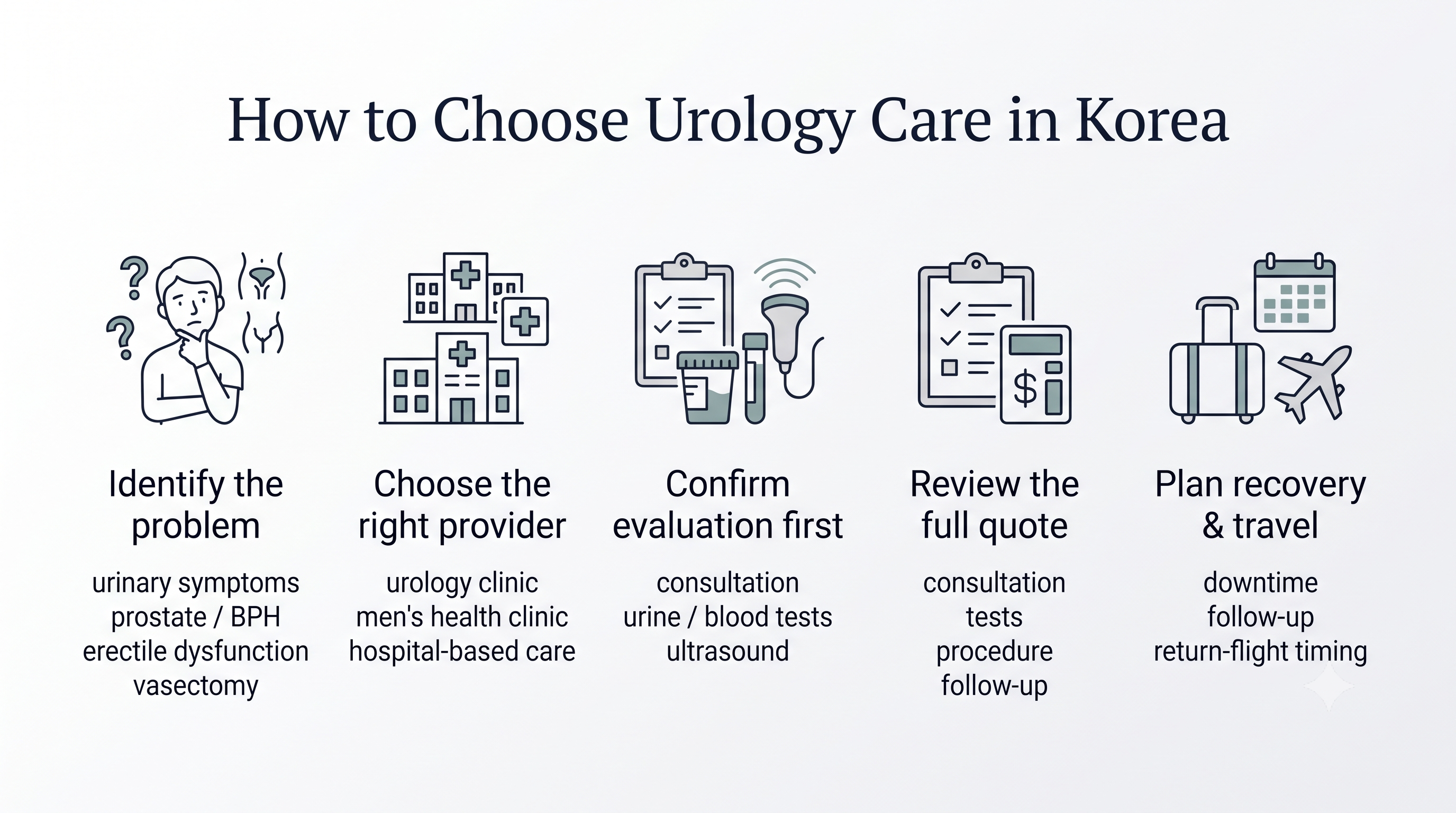
- Start with the medical problem. Urinary symptoms, BPH, ED, vasectomy, fertility and male reconstructive surgery are different clinical intents.
- Check the treating clinician and specialty. “Men’s clinic” branding alone does not establish that the provider is appropriate for a prostate, urinary or surgical problem.
- Confirm the exact service at that branch. Clinic groups can differ by location, doctor, device and procedure availability.
- Ask what evaluation comes before treatment. Appropriate care should follow symptom review and clinically relevant testing rather than a procedure-first pathway.
- Get a complete quote. Confirm consultation, diagnostics, procedure, anesthesia, medication and follow-up inclusions before travel.
- Plan recovery and follow-up before booking flights. This is especially important for surgery, catheter care, semen testing after vasectomy, and procedures requiring repeat assessment.
Urology Clinics and Hospital-Based Care in Korea
The right setting depends on the medical problem. The providers below are separated into dedicated urology/men's-health clinics and hospital-based care. This helps foreign patients compare providers by clinical setting instead of treating every “urology in Korea” result as interchangeable.
Specialist Urology & Men's Health Clinics
Provider verification: Clinic-specific services, addresses and doctor details below are based on current MTK provider records and, where noted, current provider-listed information. These details describe availability and provider identity; they are not independent evidence that one clinic or procedure is medically superior.
Chaeum Men Clinic — Jeju
JejuMen's UrologyOutpatient Clinic
Chaeum Men Clinic is an MTK-listed urology provider in Jeju focused on men's health. Current MTK data lists urology together with erectile dysfunction, vasectomy and penile enlargement categories.
- May suit: travelers already in Jeju who want a dedicated men's-urology consultation or selected outpatient male-health procedures.
- Current MTK-listed focus: urology, erectile dysfunction, vasectomy and penile enlargement.
- Location: 4F, Jeongwon Building, 3328 1100-ro, Jeju-si, Jeju.
Urogyn Men's Clinic — Busan
BusanMen's UrologyBPH
Urogyn Men's Clinic is a dedicated men's-urology provider in Busan. Current MTK data lists urology, erectile dysfunction, vasectomy and penile enlargement, while the provider's current service description also lists prostate/BPH care, premature-ejaculation treatment, STD care and semen testing.
- May suit: patients seeking men's urology in Busan, particularly ED, vasectomy or a clinic that also lists prostate/BPH procedures.
- Current MTK-listed focus: urology, erectile dysfunction, vasectomy and penile enlargement.
- Provider-listed prostate procedures: UroLift and Rezūm are among the BPH options currently described by the clinic; exact indication and availability should be confirmed before booking.
- Location: 7F, Room 702, I-ON City, 74 Seomyeon-ro, Busanjin-gu, Busan.
Seomyeon L Urology Clinic — Busan
BusanUrologyOutpatient Clinic
Seomyeon L Urology is a Busan urology clinic whose current provider information covers both traditional urology and men's-health procedures. Its prostate section lists BPH surgery, UroLift and Aquablation, together with urinary-flow and prostate-related diagnostic testing.
- May suit: patients seeking a dedicated urology clinic in central Busan, including prostate/BPH assessment or male sexual-health care.
- Provider-listed prostate care: BPH surgery, UroLift, Aquablation and prostatitis care.
- Provider-listed testing: uroflowmetry, ultrasound, post-void residual measurement, PSA and male-hormone testing.
- Other provider-listed men's-health areas: ED implants/treatment, vasectomy, premature-ejaculation procedures and circumcision.
- Location: 14F, Room 102, Lotte Hotel, 772 Gaya-daero, Busanjin-gu, Busan.
Praum Urology Clinic — Seoul
SeoulUrologyProstate
Praum Urology Clinic is a Gangnam urology clinic led by Dr. Lee Jiyoung (Lee Ji-Yong), whose current MTK profile lists him as a board-certified urologist with Ajou University Hospital training and additional prostate-clinic training at Korea University Guro Hospital.
- May suit: patients seeking specialist-led men's urology in Seoul, particularly male surgery or prostate-related consultation.
- Doctor entity: Dr. Lee Jiyoung — board-certified urologist; current MTK profile lists memberships including the Korean Urological Association, Korean Prostate Society and International Society for Sexual Medicine.
- Provider-listed prostate technology: Rezūm and UroLift are listed in the clinic's current MTK profile; exact treatment suitability must be determined clinically.
- Location: 2F, 488 Gangnam-daero, Gangnam-gu, Seoul.
Highest Urology Clinic — Seoul
SeoulUrologyProstate & Men's Health
Highst Urology Clinic is a dedicated men's-urology and surgical clinic in Gangnam. Current MTK data identifies two chief directors — Dr. Koo Jinmo and Dr. Hwang Insung — as board-certified urologists.
- May suit: patients seeking specialist-led male urology in Seoul, particularly ED surgery, vasectomy or reconstructive/male surgical care.
- Current MTK-listed focus: erectile dysfunction, vasectomy, penile enlargement and reconstruction surgery.
- Doctor entities: Dr. Koo Jinmo and Dr. Hwang Insung — both listed by MTK as board-certified urologists.
- Location: 14F–15F, 655 Seolleung-ro, Gangnam-gu, Seoul.
Hospital-Based Urology for More Complex Care
Seoul St. Mary's Hospital — Seoul
SeoulUniversity HospitalHospital-Based Urology
The Catholic University of Korea Seoul St. Mary's Hospital is a large university-hospital setting in Seoul. Within this guide, its value is not as a men's clinic but as a hospital-based option when broader diagnostics, inpatient care or multidisciplinary management may be needed.
- May suit: more complex urology cases, suspected malignancy, major surgery or patients with significant comorbidities who may benefit from a university-hospital setting.
- Current MTK men's-health categories: erectile dysfunction, vasectomy and reconstruction surgery are listed within the hospital's MTK profile.
- Additional relevant MTK program: the current international male-intensive checkup includes prostate ultrasound and a male hormone panel.
- Location: 222 Banpo-daero, Seocho-gu, Seoul.
International St. Mary's Hospital — Incheon
IncheonUniversity HospitalHospital-Based Urology
Catholic Kwandong University International St. Mary's Hospital is a university-affiliated general hospital in Incheon. It adds a hospital-based option for international patients whose urology care may require broader diagnostics, surgery, admission or coordination with other specialties.
- May suit: complex cases, major procedures or patients who prefer a hospital setting close to the Seoul–Incheon travel corridor.
- Current MTK men's-health categories: erectile dysfunction, vasectomy and reconstruction surgery are listed within the hospital's MTK profile.
- Hospital setting: current MTK information also lists broad diagnostic, surgical and emergency capabilities.
- Location: 25 Simgok-ro 100beon-gil, Seo-gu, Incheon.
Editorial note: Providers are listed in no particular order. Placement does not represent ranking, preference, endorsement or comparative superiority by Medical Travel Korea. MTK partner data is used for provider-specific service verification, while medical claims are supported separately by independent clinical sources. Exact procedures, treating clinicians, pricing, branch availability and current addresses should be reconfirmed before booking.
Ready to contact a urology provider?
Use the Direct Book button on the provider card you prefer. MTK can reconfirm the current treating clinician, relevant urology service, likely pre-visit records or testing, official quote, appointment availability and language assistance before you travel.
Urology Clinic vs University Hospital in Korea: Which Should You Choose?
A specialist urology clinic may be appropriate for many routine consultations and selected procedures, while a university or tertiary hospital may be more appropriate when the diagnosis is complex, cancer is suspected, major inpatient surgery may be needed, or several specialties are involved.
| Setting | May be appropriate for | What to confirm |
|---|---|---|
| Specialist urology clinic | Routine urinary symptoms, ED, vasectomy, selected BPH care and outpatient male-urology procedures. | Treating clinician, exact procedure, diagnostics available, anesthesia and follow-up. |
| University / tertiary hospital | Complex disease, suspected cancer, major surgery, inpatient care or cases involving multiple specialties. | Referral/pre-assessment requirements, records needed, admission planning and length of stay. |
Seoul, Busan, Jeju or Incheon for Urology Care?
Incheon: International St. Mary's Hospital adds a hospital-based option for patients who may need broader diagnostics, inpatient care or multidisciplinary coordination.
Choose clinical fit before convenience. A provider close to your hotel is not automatically the better option if the required test, procedure, inpatient capability or follow-up pathway is unavailable there. Travelers searching for an English-speaking urologist in Seoul should also confirm whether English is provided directly by the clinician or through an international coordinator or medical interpreter.
Explore Urology Topics in Korea
This is MTK’s broad urology in Korea pillar guide. Procedure-specific questions such as BPH treatment, HoLEP, prostate screening, erectile dysfunction, vasectomy and vasectomy reversal are better handled in focused guides so each topic can explain indications, testing, recovery and travel planning in appropriate detail.
Prostate & Urinary Care
- BPH / Enlarged Prostate Treatment in Korea — diagnosis, medication, minimally invasive options and surgery.
- HoLEP in Korea — when laser enucleation is considered, recovery and treatment planning.
- Prostate Screening in Korea — distinguishing symptom evaluation, PSA-based screening questions and diagnostic assessment.
Men's Sexual & Reproductive Health
- Erectile Dysfunction Treatment in Korea — evaluation and treatment options.
- Vasectomy in Korea — permanence, preparation, follow-up and travel planning.
- Vasectomy Reversal in Korea — specialist evaluation and fertility-focused decision-making.
Recovery
Focused topic names above are editorial roadmap topics unless a link is shown. They are not presented as existing pages or as treatment recommendations.
Frequently Asked Questions About Urology in Korea
Yes. Some urology clinics and hospital international centers in Korea provide direct English communication, while others use coordinators or medical interpreters. Confirm the exact language-support model before booking, especially if you need to discuss surgery, risks, consent or follow-up in detail.
There is no single nationwide urology price or one standardized foreign-patient fee. Final cost can vary by provider, insurance or self-pay status, required tests, procedure, anesthesia, medication and follow-up. Ask for the selected provider’s written current quote and inclusions before traveling.
If available, send relevant prior diagnoses, medication lists, laboratory results, PSA or hormone results, ultrasound or imaging reports, operative records and previous urology treatment history. The receiving clinic should confirm which records are actually needed for your specific consultation.
Yes. International patients can use participating urology clinics in Korea. Clinics listed through MTK must hold Registered Foreign Patient Attraction Institution status before booking access is provided through the platform, and MTK can arrange language assistance for the visit.
The current Korean specialty term is 비뇨의학과 (urological medicine/urology). Older signage or everyday usage may still use 비뇨기과.
Not always. “Men’s health clinic” is a broad consumer-facing label. Some are urology clinics, while others focus on male surgery, sexual health, aesthetics or wellness. Check the treating specialty and the exact services offered.
Common reasons include urinary frequency or urgency, weak urine flow, difficulty emptying the bladder, prostate concerns, erectile dysfunction, testicular or scrotal symptoms and other urinary or male reproductive problems. Acute or severe symptoms may require urgent local care rather than travel planning.
Yes, but there is no single universal “prostate check.” Evaluation may include symptom review, physical examination, urine testing, blood testing such as PSA when clinically appropriate, ultrasound or other tests depending on age, symptoms, risk factors and clinician judgment.
No. Lower urinary tract symptoms can have multiple causes, and prostate size does not perfectly predict symptom severity. A urologic assessment should determine the likely cause before treatment is selected.
Yes. Some urology and men's-health clinics in Korea evaluate and treat ED. An appropriate assessment should consider medical, sexual and mental-health history and possible underlying causes rather than selecting a procedure based only on advertising.
Selected MTK partner clinics list vasectomy, and at least one current partner listing includes vasectomy reversal. The exact procedure, eligibility, recovery plan and follow-up requirements should be confirmed before travel.
There is no single national price. Consultation, laboratory tests, ultrasound, procedures, anesthesia and surgery are priced differently by clinic and clinical need. MTK can confirm the selected clinic's current official quote before booking.
No. Clinics booked through MTK can provide international patients with language assistance, with interpreters experienced in medical terminology arranged through the platform.
A specialist urology clinic may be suitable for many routine consultations and selected outpatient procedures. A university or tertiary hospital may be more appropriate if cancer is suspected, major inpatient surgery is being considered, the diagnosis is complex or several specialties need to be involved.
Not every private urology consultation requires a referral, but requirements can differ by clinic, hospital and procedure. International patients should confirm the selected provider’s booking and pre-assessment requirements before travelling.
There is no single stay length. A consultation or selected office-based care may require little additional time, while surgery, catheter management, wound review or repeat testing may require a longer stay. Confirm the follow-up plan before booking flights.
Medical References
Source policy: Clinical statements in this guide use peer-reviewed urology research, Korean professional guidance, government health institutions and international professional urology guidelines. Clinic-specific operational facts are verified separately through MTK partner data and are not used as medical evidence.
- Yoo TK, Lee KS, et al. The prevalence of lower urinary tract symptoms in population aged 40 years or over, in South Korea. Investigative and Clinical Urology. 2018;59(3):166–176.
- Jeh S, Choi M, et al. The epidemiology of male lower urinary tract symptoms associated with benign prostatic hyperplasia: Results of 20 years of Korean community care and surveys. Investigative and Clinical Urology. 2024;65(1):69–76.
- Yeo JK, Choi H, et al. Korean clinical practice guideline for benign prostatic hyperplasia. Investigative and Clinical Urology. 2016;57(1):30–44.
- European Association of Urology. Guidelines on the Management of Non-neurogenic Male Lower Urinary Tract Symptoms, 2026.
- European Association of Urology. Male LUTS — Diagnostic Evaluation, 2026.
- National Institute of Diabetes and Digestive and Kidney Diseases (NIDDK). Prostate Problems.
- NIDDK. Erectile Dysfunction.
- European Association of Urology. Sexual and Reproductive Health Guidelines, 2026.
Medical Disclaimer: This guide is for general educational purposes only and does not replace diagnosis, treatment planning or advice from a licensed medical professional. Urologic symptoms can have multiple causes, and treatment suitability depends on individual history, examination and testing. Acute urinary retention, fever with painful urinary symptoms, blood in the urine or significant urinary-tract pain should be evaluated promptly. Current clinic services, pricing and procedural availability should be reconfirmed before travel.