
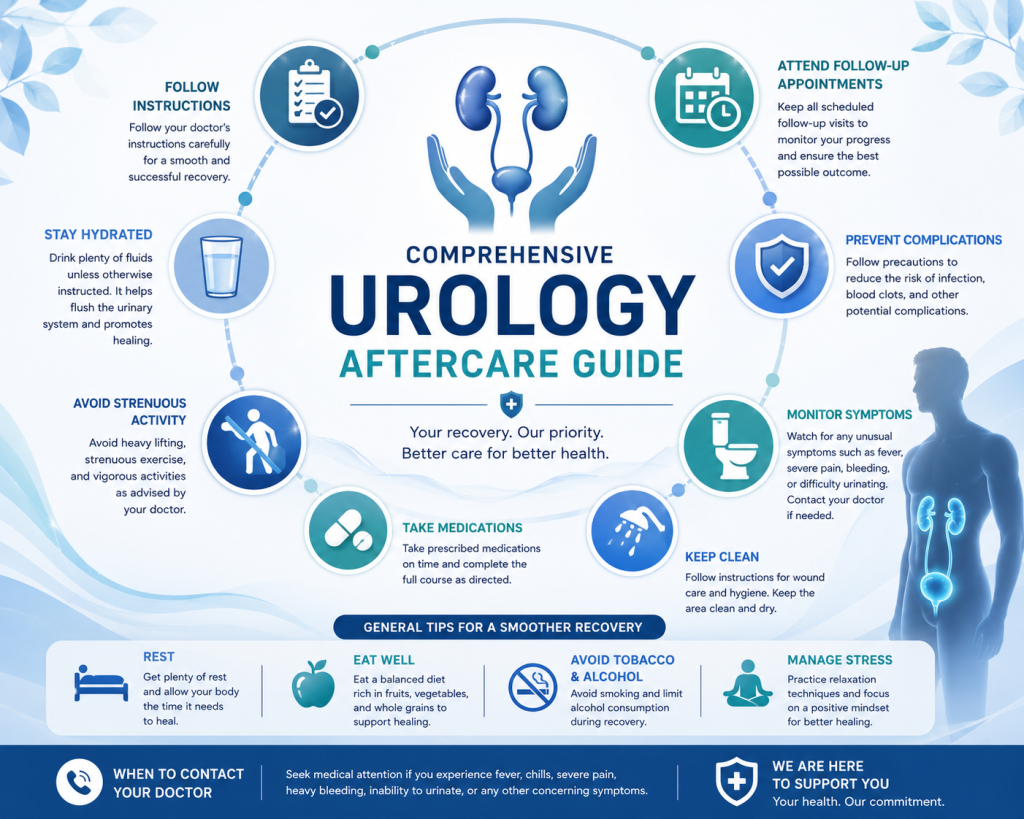
UROLOGY AFTERCARE GUIDES
1. Erectile Dysfunction Treatment - Aftercare Guide
- Treatment varies depending on type (medication, injection, implant, or device)
- Oral medications: take as prescribed; effects typically occur within 30-60 minutes
- Avoid alcohol, especially with oral medications (may reduce effectiveness)
- Avoid grapefruit juice (interferes with some medications)
- Penile injections: follow injection technique training carefully
- Clean injection site before administration
- Rotate injection sites to prevent tissue damage
- Use sterile needles and follow sterile technique
- Report bruising, swelling, or pain at injection site
- Vacuum erection devices: use as instructed; follow usage guidelines
- Do not exceed recommended duration of use with device
- Penile implant surgery: avoid sexual activity for 4-6 weeks
- Keep surgical site clean and dry after implant surgery
- Attend all follow-up appointments
- Implant activation typically delayed 4-6 weeks after surgery
- Use adequate lubrication with implant
- Follow specific instructions for your implant type
- Report any pain, infection signs, or device malfunction
- Psychological support may be beneficial
- Maintain overall cardiovascular health
- Continue any prescribed blood pressure medications
- Regular follow-up assessments important
- Results and satisfaction improve with consistent use
2. Prostate Surgery (TURP, AquaBlation) - Aftercare Guide
- Urinary catheter may be in place initially (typically 1-3 days)
- Drink plenty of water (2-3 liters daily) to flush system
- Urinary frequency and urgency normal initially
- Burning with urination may occur (typically resolves in days)
- Blood in urine common initially; gradually clears
- Prescribed antibiotics prevent infection; take as directed
- Pain management with prescribed or over-the-counter medication
- Avoid strenuous exercise and heavy lifting for 2-4 weeks
- No sexual activity for 4-6 weeks after surgery
- Avoid straining or constipation
- Keep surgical area clean and dry
- Sitz baths (warm water) helpful for comfort (after catheter removal)
- Avoid very hot baths initially
- Continue good hygiene; gentle washing of area
- Avoid smoking and tobacco products
- Avoid alcohol, especially with medications
- Return for follow-up appointments
- Urinary symptoms typically improve significantly
- Most patients return to normal activities within 1-2 weeks
- Full recovery typically 4-6 weeks
- Irrigation fluid absorption may cause temporary confusion or restlessness
- Report fever, inability to urinate, or severe pain immediately
3. Vasectomy - Aftercare Guide
- Mild discomfort and swelling expected for first few days
- Apply ice packs for first 24-48 hours (20 minutes on, 20 minutes off)
- Keep head elevated; wear supportive underwear
- Prescribed pain medication for discomfort
- Avoid touching or disturbing surgical site
- Keep incision clean and dry
- No showering for first 24 hours; sponge baths acceptable
- After 24 hours: gentle cleansing acceptable
- Avoid strenuous exercise and heavy lifting for 1 week
- No sexual activity for 1 week minimum
- Avoid swimming and water activities for 1 week
- Return to work: typically 2-3 days for desk work
- Return to strenuous activity: 2 weeks
- Sperm count testing required 8-12 weeks post-op
- Must use backup contraception until sperm count confirmed zero
- Two consecutive zero sperm counts confirm sterility
- This is a permanent procedure; reversal possible but not guaranteed
- Ejaculation volume unchanged
- Sexual function typically unaffected
- Attend follow-up appointments for sperm count verification
- Report excessive bleeding, infection signs, or severe pain
- Pain typically resolves within 1-2 weeks
4. Vasectomy Reversal - Aftercare Guide
- Mild to moderate discomfort expected initially
- Apply ice packs for first 24-48 hours (20 minutes on, 20 minutes off)
- Wear supportive underwear for comfort and protection
- Keep head elevated while resting
- Prescribed pain medication for discomfort
- Prescribed antibiotics prevent infection; take as directed
- Avoid touching or disturbing surgical site
- Keep incision clean and dry
- No showering for first 24 hours; sponge baths after
- After 24 hours: gentle cleansing acceptable
- Avoid strenuous exercise and heavy lifting for 2-3 weeks
- No sexual activity for 2-3 weeks minimum
- Avoid swimming and water activities for 2 weeks
- Return to work: typically 3-4 days for desk work
- Return to strenuous activity: 3-4 weeks
- Sperm count testing begins 8-12 weeks post-op
- Regular sperm count monitoring important for success assessment
- Success rates 50-75% for sperm return
- Even without sperm in ejaculate, conception possible with assisted reproductive techniques
- Fertility success depends on time since original vasectomy
- Attend all follow-up appointments
- Discuss realistic expectations with surgeon
- Report excessive bleeding, infection signs, or severe pain
- Swelling may persist for several weeks
5. Circumcision - Aftercare Guide
- Mild to moderate discomfort expected for first few days
- Apply ice packs for first 24 hours (20 minutes on, 20 minutes off)
- Wear loose, comfortable clothing (avoid tight underwear)
- Prescribed pain medication for discomfort
- Prescribed antibiotics prevent infection; take as directed
- Keep incision clean and dry
- No showering for first 24 hours; sponge baths acceptable
- After 24 hours: gentle cleansing with warm water
- Pat dry gently; avoid rubbing
- Avoid sexual activity and masturbation for 3-4 weeks
- Avoid strenuous exercise and heavy lifting for 1 week
- Swelling peaks at 48-72 hours; gradually improves
- Some bleeding or oozing normal for first few days
- Erections may be uncomfortable initially (normal)
- Avoid swimming and water activities for 2 weeks
- Return to work: typically 3-5 days for desk work
- Return to strenuous activity: 2-3 weeks
- Sutures typically dissolve or removed at 10-14 days
- Incision should be completely healed in 3-4 weeks
- Sensitivity improvement continues over weeks
- Ejaculation may feel different initially (typically improves)
- Report excessive bleeding, infection signs, or severe pain
- Avoid tight clothing that irritates incision
6. Benign Prostatic Hyperplasia (BPH) Laser Treatment - Aftercare Guide
- Mild burning with urination expected initially
- Blood in urine common and normal initially
- Urinary frequency may increase temporarily
- Drink plenty of water (2-3 liters daily) to flush system
- Prescribed antibiotics prevent infection; take as directed
- Pain medication for any discomfort
- Urinary catheter may be in place briefly
- Avoid strenuous exercise and heavy lifting for 2 weeks
- No sexual activity for 2-3 weeks
- Avoid straining or constipation
- Sitz baths helpful for comfort
- Avoid smoking and tobacco products
- Avoid alcohol, especially with medications
- Return for follow-up appointments
- Symptoms typically improve significantly within weeks
- Most patients return to normal activities within 1 week
- Full recovery typically 2-4 weeks
- Improved urinary flow usually noticeable
- Nighttime urination frequency typically decreases
- Report fever, inability to urinate, or severe pain immediately
7. Urinary Incontinence Treatment - Aftercare Guide
- Treatment type varies (medication, device, or surgical)
- Medication-based treatment: take as prescribed
- Avoid medications that worsen incontinence
- Pelvic floor exercises important for success
- Continue exercises as instructed even after treatment
- Mid-urethral slings or other implants: avoid strenuous activity for 2-4 weeks
- No sexual activity for 2-3 weeks after surgical implant
- Keep surgical site clean and dry
- Prescribed antibiotics prevent infection
- Pain medication for discomfort
- Urinary symptoms may take weeks to fully resolve
- Multiple follow-up visits may be needed
- Adjustments to medication or device possible
- Success rates improve with compliance
- Lifestyle modifications support treatment effectiveness
- Adequate fluid intake important
- Bladder training exercises helpful
- Avoid excessive caffeine and alcohol
- Report worsening symptoms or inability to urinate
- Realistic expectations about outcome important
8. Kidney Stone Treatment (Ureteroscopy/Lithotripsy) - Aftercare Guide
- Mild discomfort in back or side expected
- Blood in urine common and normal initially
- Burning with urination may occur temporarily
- Drink plenty of water (2-3 liters daily) to flush system
- Prescribed pain medication for discomfort
- Prescribed antibiotics prevent infection; take as directed
- Stent may be in place temporarily (typically 1-2 weeks)
- Follow-up imaging to confirm stone removal
- Avoid strenuous exercise and heavy lifting for 1-2 weeks
- No sexual activity for 1 week minimum
- Avoid swimming and water activities for 1 week
- Continue hydration important
- Return to light activity gradually
- Fever or inability to urinate requires immediate attention
- Dietary modifications may be recommended to prevent recurrence
- Follow-up appointments important
- Stone analysis results guide prevention strategy
- Most patients return to normal activities within 1 week
- Full recovery typically 2-4 weeks
- Stent removal appointment scheduled if applicable
- Pain should steadily improve
- Report severe flank pain or fever immediately
9. Hydrocele/Varicocele Repair - Aftercare Guide
- Mild discomfort and swelling expected
- Apply ice packs for first 24-48 hours (20 minutes on, 20 minutes off)
- Wear supportive underwear for comfort and protection
- Prescribed pain medication for discomfort
- Prescribed antibiotics prevent infection; take as directed
- Keep surgical site clean and dry
- No showering for first 24 hours; sponge baths acceptable
- After 24 hours: gentle cleansing acceptable
- Avoid strenuous exercise and heavy lifting for 2-3 weeks
- No sexual activity for 2-3 weeks
- Avoid swimming and water activities for 2 weeks
- Swelling peaks at 48-72 hours; gradually improves
- Some bruising normal
- Sutures typically dissolve or removed at 10-14 days
- Return to light activity: 1 week
- Return to strenuous activity: 3-4 weeks
- Improvement in symptoms gradual
- Success rates high with good compliance
- Report excessive bleeding, infection signs, or severe pain
- Scrotal elevation helpful for comfort
10. Urinary Tract Infection (UTI) Treatment - Aftercare Guide
- Complete full course of antibiotics (typically 7-14 days)
- Do not stop antibiotics early even if feeling better
- Drink plenty of water (2-3 liters daily)
- Urinary frequency normal during treatment
- Burning with urination should gradually improve
- Pain medication for discomfort if needed
- Avoid alcohol while taking antibiotics
- Avoid sexual activity until symptoms resolve
- Avoid irritating substances (douches, spermicides)
- Increase acidic foods to promote acidic urine
- Avoid caffeine and spicy foods
- Use heating pad for bladder discomfort
- Cranberry juice may help prevent recurrence
- Void frequently; do not hold urine
- Symptoms typically improve within 24-48 hours
- Complete symptom resolution expected after full course
- Follow-up testing may be recommended if recurrent
- Prophylactic antibiotics possible for recurrent infections
- Preventive measures important: hydration, hygiene, frequent urination
- Report fever, back pain, or blood in urine to physician
GENERAL UROLOGY AFTERCARE PRINCIPLES
Immediate Post-Operative Period (First 24 Hours)
- Take prescribed antibiotics and pain medication as directed
- Rest and keep area elevated
- Apply ice packs for first 24 hours if recommended
- Avoid disturbing surgical site
- Keep incision clean and dry
- Avoid showering or bathing for first 24 hours
- Wear supportive underwear or loose clothing
- Do not exercise or lift heavy objects
- Avoid sexual activity
- Drink plenty of fluids
- Avoid alcohol and tobacco products
- Report excessive bleeding or severe pain immediately
- Do not drive if taking pain medications
First Week
- Continue prescribed antibiotics if given
- Discomfort gradually improves
- Apply ice packs if swelling persists
- Sitz baths helpful for comfort (after first 24 hours)
- Gentle cleansing of area acceptable
- Avoid strenuous exercise and heavy lifting
- No sexual activity
- Avoid swimming and water activities
- Continue excellent hygiene
- Attend follow-up appointments
- Report fever, infection signs, or severe pain
- Swelling and discomfort should gradually improve
- Light activity resumable by end of week 1
- Return to work acceptable for desk jobs
Weeks 2-4
- Continue prescribed medications if still prescribed
- Gradual return to normal activities
- Resume light exercise and walking
- Avoid heavy lifting for full recovery period
- No sexual activity until cleared (typically 3-4 weeks minimum)
- Continue good hygiene and incision care
- Attend all follow-up appointments
- Sutures removed as scheduled if not dissolving
- Any remaining discomfort should minimal
- Return to strenuous activity gradually
- Report any delayed healing or complications
Long-Term Care (Month 2 and Beyond)
- Complete healing timeline varies by procedure (2-8 weeks)
- Final results visible after complete healing
- Continue excellent hygiene habits
- Regular follow-up appointments as recommended
- Maintain overall health
- Report any problems immediately
- Long-term success depends on compliance
- Discuss sexual function restoration timeline with physician
- Preventive measures important (hydration, activity, hygiene)
WARNING SIGNS: WHEN TO CONTACT YOUR UROLOGIST
Contact Immediately:
- Severe pain not relieved by prescribed medication
- Excessive bleeding or continuous oozing
- Fever above 101°F (38.3°C)
- Pus, discharge, or foul odor from surgical site
- Inability to urinate or urinary retention
- Severe swelling or tightness
- Signs of infection (redness, warmth, increasing drainage)
- Blood clots or large amounts of blood in urine
- Allergic reaction (rash, difficulty breathing, throat swelling)
- Severe dizziness or fainting
- Chest pain or difficulty breathing
Contact Within 24 Hours:
- Mild fever (under 101°F)
- Mild discharge
- Swelling worse than expected
- Questions about prescribed medications
- Difficulty following post-operative instructions
- Unexpected urinary symptoms
- Mild bleeding or oozing
Schedule Follow-Up Appointment:
- Post-operative check-up (1-2 weeks)
- Suture removal (typically 10-14 days)
- Sperm count testing (vasectomy: 8-12 weeks)
- Device adjustment appointments (as needed)
- Regular maintenance appointments (as recommended)
- Follow-up imaging or testing (as needed)
ESSENTIAL DO'S AND DON'TS
DO:
- Follow all physician's instructions carefully
- Take all prescribed medications as directed
- Attend all scheduled follow-up appointments
- Wear supportive underwear
- Keep surgical site clean and dry
- Apply ice packs for first 24-48 hours
- Keep area elevated when resting
- Drink plenty of water
- Rest adequately
- Use pain medication as needed
- Report problems immediately
- Maintain excellent hygiene
- Be patient with healing process
- Continue taking antibiotics even if feeling better
- Keep follow-up contact information available
DON'T:
- Don't disturb or touch surgical site
- Don't shower or bathe for first 24 hours
- Don't engage in sexual activity (3-4+ weeks depending on procedure)
- Don't exercise or lift heavy objects during recovery
- Don't drink alcohol, especially with medications
- Don't smoke or use tobacco products
- Don't wear tight clothing around surgical area
- Don't skip prescribed antibiotics
- Don't drive while taking pain medications
- Don't neglect hygiene
- Don't ignore signs of infection or complications
- Don't engage in strenuous activity too early
- Don't resume sexual activity without physician approval
- Don't hesitate to call physician with concerns
- Don't use old or contaminated wound dressings
LONG-TERM CARE AND HEALTH MAINTENANCE
Healing Timeline
- Superficial wound healing: 7-14 days
- Internal healing and scar formation: 4-8 weeks
- Full recovery timeline varies by procedure (2-12 weeks)
- Some symptoms may persist beyond visible healing
- Final results may take weeks to months to stabilize
Maintaining Urological Health
- Regular urological check-ups as recommended
- Annual health screening important
- Maintain healthy lifestyle and fitness
- Adequate hydration supports urological health
- Regular sexual activity beneficial for health
- Pelvic floor exercises maintain function
- Preventive measures reduce complication risk
- Discuss long-term follow-up schedule with physician
Sexual Function Recovery
- Timeline varies by procedure (2-12 weeks)
- Psychological factors important for recovery
- Communication with partner helpful
- Gradual return to sexual activity recommended
- Lubrication may be helpful during recovery
- Report persistent sexual dysfunction to physician
- Most sexual function returns to baseline
- Realistic expectations about outcomes important
Preventive Health Measures
- Maintain adequate hydration (6-8 glasses daily)
- Healthy diet supports overall urological health
- Regular exercise benefits cardiovascular health
- Avoid smoking and excessive alcohol
- Maintain healthy weight
- Regular physical activity recommended
- Manage stress effectively
- Discuss preventive strategies with physician
- Report urinary or sexual symptoms promptly
SPECIAL CONSIDERATIONS FOR INTERNATIONAL PATIENTS
Pre-Departure Guidelines
- Schedule final check-up before flying home
- Obtain copies of all medical records and pathology results
- Get written post-operative care instructions in English
- Request prescriptions for any medications needed
- Confirm follow-up testing timeline (sperm count, etc.)
- Arrange telemedicine follow-ups if available
- Obtain emergency contact information
- Keep all documentation in carry-on bag
- Ask about safe timing for air travel
- Understand when activities can resume
Travel Precautions
- Avoid flying immediately after surgery if possible
- Most procedures allow flying after 3-7 days
- Avoid sitting for extended periods if possible
- Wear comfortable, loose clothing during travel
- Pack prescribed medications in carry-on
- Bring extra medications in case of delays
- Stay well-hydrated during flight
- Avoid smoking areas
- Avoid strenuous activity during travel
- Wear compression underwear if recommended
Ongoing International Care
- Telemedicine consultations possible for routine follow-ups
- Local urologist can coordinate with Korean clinic
- Medical records and imaging provided for local care
- Prescriptions valid in most countries (verify)
- Maintain contact with Korean clinic for guidance
- Report any complications to both physicians
- Follow-up visits to Korea possible if needed for major issues
- Annual health check-ups in home country recommended
- Keep all documentation for future reference
- Discuss long-term follow-up plan before departure