
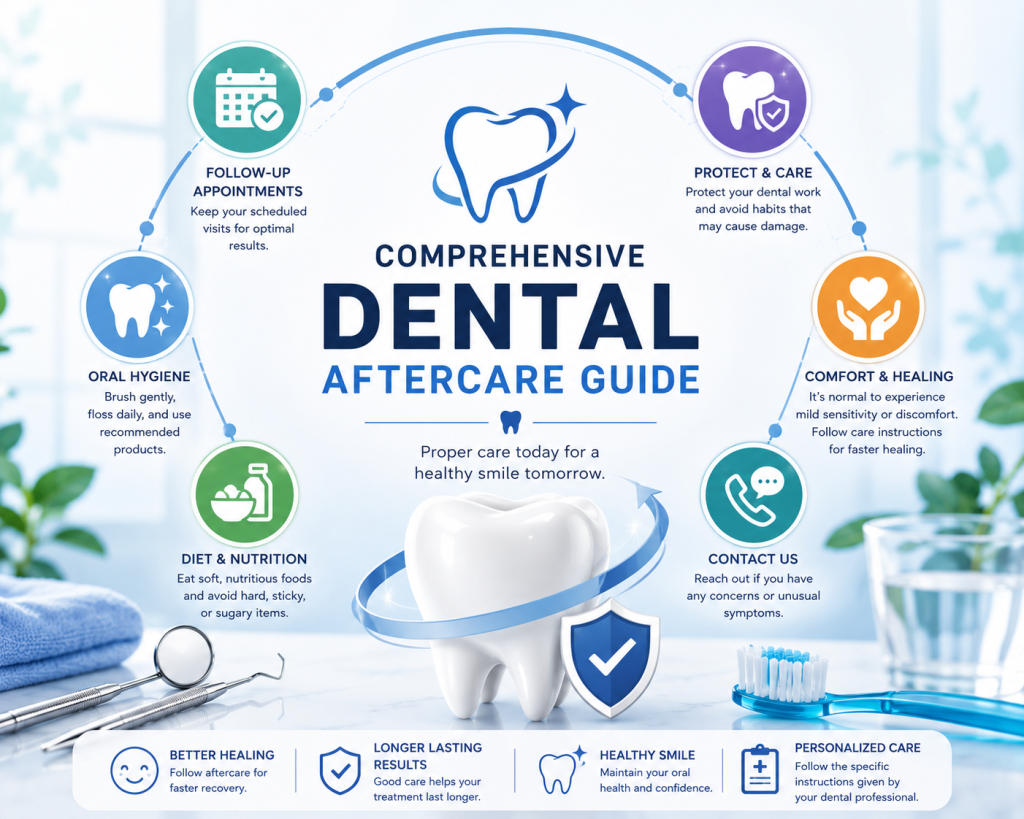
DENTAL AFTERCARE GUIDES
1. Dental Implant Surgery - Aftercare Guide
- Mild to moderate swelling and discomfort expected (peaks at 48-72 hours)
- Prescribed antibiotics prevent infection; take as directed
- Pain management with prescribed pain medication
- Avoid touching, pressing, or disturbing surgical site
- Bite gently on gauze for 30-45 minutes; change if bleeding continues
- Apply ice packs for first 24 hours (20 minutes on, 20 minutes off)
- Keep head elevated, especially during sleep (first 3-4 nights)
- Avoid rinsing, spitting, or smoking for first 24 hours
- Do not drink through straws for 1 week
- Avoid hot foods and beverages for first week
- Soft foods only for first 2 weeks
- No strenuous exercise for 1 week
- Avoid heavy lifting for 4-6 weeks
- Avoid swimming and water activities for 2 weeks
- Take prescribed antibiotics and pain medication as directed
- Return for follow-up appointments (typically 7-14 days)
- Sutures usually removed at 7-10 days post-op
2. Tooth Extraction - Aftercare Guide
- Keep gauze in place for 30-45 minutes after extraction
- Bite firmly but gently on gauze; change if bleeding persists
- Do not disturb extraction site
- Avoid rinsing, spitting, or touching area for first 24 hours
- Apply ice packs for first 24 hours (20 minutes on, 20 minutes off)
- Keep head elevated while resting
- Swelling peaks at 24-48 hours; gradually improves
- Take prescribed pain medication as directed
- Avoid hot foods and beverages for first week
- Stick to soft foods for first few days
- Do not use straws for 1 week
- Avoid smoking for at least 72 hours (ideally 1 week)
- Avoid alcohol, especially with pain medications
- No strenuous exercise for 3-4 days
- Gentle salt water rinses after 24 hours (warm salt water, 4-5 times daily)
- Do not exercise vigorously until fully healed
- Avoid dry socket behaviors (smoking, straws, spitting)
- Return for follow-up if excessive bleeding or severe pain occurs
- Healing typically complete in 7-14 days
3. Root Canal Treatment - Aftercare Guide
- Tooth may feel tender and sensitive immediately after treatment
- Prescribed antibiotics prevent infection; take as directed
- Avoid chewing on treated tooth until permanent restoration placed
- Pain management with prescribed or over-the-counter pain medication
- Sensitivity to temperature changes is normal (may last days to weeks)
- Avoid hard, sticky, or crunchy foods
- Do not bite down on treated tooth
- Avoid very hot or very cold foods and beverages
- Soft diet recommended for first few days
- Gradual return to normal diet as comfort allows
- Do not smoke or use tobacco products
- Avoid alcohol, especially with pain medications
- Continue good oral hygiene; brush gently around treated tooth
- Do not rinse or spit forcefully for first 24 hours
- Return for permanent restoration (typically within 2 weeks)
- Take all prescribed antibiotics even if feeling better
- Report excessive pain or swelling to dentist
- Final restoration critical for long-term success
- Healing typically 1-2 weeks before restoration placement
4. Teeth Whitening (Professional) - Aftercare Guide
- Mild tooth sensitivity expected (usually temporary)
- Avoid dark-colored foods and beverages for 48 hours
- Avoid red wine, coffee, tea, cola, and tobacco for first week
- Use whitening toothpaste if sensitivity develops
- Sensitivity toothpaste helpful for managing discomfort
- Avoid very hot or very cold foods and drinks
- Do not smoke or use tobacco products
- Avoid acidic foods and beverages (citrus, vinegar)
- Results most visible immediately; slight shade change possible
- Results typically last 6-12 months
- Maintenance treatments recommended every 6-12 months
- Custom whitening trays may be provided for touch-ups
- Follow-up whitening sessions possible as needed
- Professional whitening more effective than at-home kits
- Avoid staining beverages by using straws
- Results vary based on tooth structure and staining
- No dietary restrictions after first week
5. Dental Crowns and Veneers - Aftercare Guide
- Temporary crown may be placed initially
- Temporary crown should not be chewed on
- Avoid sticky or hard foods with temporary crown
- Avoid very hot or cold foods and beverages
- Temporary crown may be slightly loose; report to dentist
- Bite should feel comfortable; report abnormal bite
- Permanent crown usually placed within 2 weeks
- After permanent crown placement, normal biting acceptable
- Avoid chewing directly on crown for first 24 hours
- Bite adjustment may be needed after placement
- Crowned tooth can decay if margins not sealed well
- Excellent oral hygiene around crown essential
- Regular flossing around crown prevents decay
- Avoid very hard foods and ice chewing
- Avoid grinding teeth; night guard recommended if needed
- Crowns typically last 5-15 years with good care
- Veneers require gentler care than natural teeth
- Veneers do not withstand hard impact
- Avoid opening packages with teeth
- Report any sensitivity or bite issues immediately
6. Dental Bonding - Aftercare Guide
- Bonded material sets within 24 hours
- Avoid hard, sticky, or crunchy foods for first week
- Avoid very hot or very cold foods and beverages
- Do not bite directly on bonded area
- Avoid smoking and tobacco products
- Avoid dark-colored beverages (coffee, tea, red wine)
- Gentle brushing around bonded area
- Floss gently around bonded area
- Bonding material more stain-prone than natural tooth
- Results last 3-10 years depending on location and care
- Regular dental maintenance important for longevity
- Sensitivity possible; use sensitivity toothpaste if needed
- Report any chipping or damage immediately
- Repair or replacement possible if damage occurs
- Avoid habits like nail biting or ice chewing
- Avoid grinding teeth; night guard recommended
7. Wisdom Tooth Extraction - Aftercare Guide
- Bite on gauze for 30-45 minutes after extraction
- More swelling expected than simple extraction (peaks 48-72 hours)
- Significant swelling and bruising normal
- Keep head elevated for first 3-4 nights
- Apply ice packs for first 24-48 hours (20 minutes on, 20 minutes off)
- Switch to warm compresses after 48 hours for pain relief
- Prescribed antibiotics prevent infection; take as directed
- Prescribed pain medication for discomfort
- Avoid rinsing, spitting, or touching area for first 24 hours
- Avoid straws, smoking, and alcohol for first week
- Soft foods only for first few days
- Avoid hot foods and beverages initially
- No strenuous exercise for 3-4 days minimum
- Avoid heavy lifting for 1 week
- Jaw stiffness normal; gradually improves
- Difficulty opening mouth may persist for few days
- Dry socket risk (avoid smoking, straws, spitting, vigorous rinsing)
- Salt water rinses after 24 hours (4-5 times daily)
- Sutures removed at 7-10 days post-op
- Complete healing 2-3 weeks
- Return for follow-up if complications develop
- Pain should steadily improve; increasing pain suggests complication
8. Scaling and Root Planing (Deep Cleaning) - Aftercare Guide
- Mild gum tenderness and sensitivity expected
- Tooth sensitivity may develop (temporary)
- Avoid hard, sticky, or crunchy foods for few days
- Avoid very hot foods and beverages initially
- Stick to soft diet for first 24-48 hours
- Use sensitivity toothpaste if sensitivity develops
- Take prescribed antibiotics as directed (if given)
- Gentle brushing around treated areas
- Avoid strenuous brushing initially
- Gentle flossing around treated areas
- Avoid mouthwash with alcohol
- Use salt water rinses (warm salt water) for comfort
- Avoid smoking and tobacco products
- Avoid alcohol, especially if prescribed antibiotics
- Gum discomfort typically resolves within 24-48 hours
- Sensitivity may persist for days to weeks
- Regular follow-up appointments important
- Good oral hygiene critical for healing
- May require multiple sessions depending on severity
- Results improve with consistent home care
- Prevention of future disease critical
GENERAL DENTAL AFTERCARE PRINCIPLES
Immediate Post-Operative Period (First 24 Hours)
- Take prescribed antibiotics and pain medication as directed
- Avoid disturbing surgical or treated site
- Do not rinse, spit, or touch area
- Bite on gauze if bleeding (change every 30-45 minutes)
- Apply ice packs for first 24 hours (20 minutes on, 20 minutes off)
- Keep head elevated above heart level
- Avoid straws, smoking, and alcohol
- Stick to soft, cool foods
- Do not exercise or lift anything heavy
- Avoid very hot foods and beverages
- Rest is critical for healing
- Report excessive bleeding or severe pain immediately
- Do not drive if taking pain medications
- Avoid touching or probing surgical site
- Use prescribed pain medication before pain becomes severe
First Week
- Continue prescribed antibiotics if given
- Swelling and discomfort gradually improve
- Switch to warm compresses after 48 hours if helpful
- Take pain medication only as needed
- Maintain soft diet
- Avoid hard, sticky, or crunchy foods
- Avoid very hot or very cold foods and drinks
- Do not use straws
- Avoid smoking and tobacco products
- Avoid alcohol, especially with medications
- Gentle mouth care around treated area
- Salt water rinses after 24 hours (warm, 4-5 times daily)
- Continue good oral hygiene away from treated area
- No strenuous exercise
- Attend follow-up appointments as scheduled
- Report any signs of infection (fever, increased swelling, discharge)
- Sensitivity and discomfort should gradually improve
- Sutures removed as scheduled (typically 7-10 days)
Weeks 2-4
- Continue prescribed medications if still prescribed
- Gradually return to normal foods
- Discomfort should be minimal by end of week 1-2
- Return to normal exercise gradually
- Continue excellent oral hygiene
- Attend all scheduled follow-up appointments
- Any remaining sensitivity typically resolves
- Staining or discoloration possible depending on procedure
- Return to normal activities as cleared
- Report any delayed healing or complications
- Prevention of future problems essential
- Permanent restoration placement for some procedures
Long-Term Care (Month 2 and Beyond)
- Complete healing typically 4-8 weeks depending on procedure
- Final results visible after complete healing
- Excellent oral hygiene prevents complications
- Regular dental check-ups important
- Professional cleanings as recommended
- Avoid habits that damage work (grinding, clenching, nail biting)
- Night guard recommended if grinding teeth
- Continue sensitivity management if needed
- Maintain overall oral health
- Report any problems immediately
- Long-term success depends on home care
WARNING SIGNS: WHEN TO CONTACT YOUR DENTIST
Contact Immediately:
- Severe pain not relieved by prescribed medication
- Excessive bleeding that doesn't stop after 30-45 minutes
- Fever above 101°F (38.3°C)
- Pus, discharge, or foul odor from site
- Severe swelling affecting breathing or swallowing
- Signs of infection (increasing redness, warmth, swelling)
- Jaw locking or severe difficulty opening mouth
- Numbness or tingling that doesn't resolve
- Allergic reaction (rash, difficulty breathing, throat swelling)
- Loose or displaced crown, implant, or bonding
- Damage to adjacent teeth
Contact Within 24 Hours:
- Mild fever (under 101°F)
- Mild discharge
- Swelling worse than expected
- Questions about prescribed medications
- Difficulty following post-operative instructions
- Bracket or wire damage (orthodontics)
- Alignment issues (clear aligners)
- Unexpected sensitivity
Schedule Follow-Up Appointment:
- Suture removal (typically 7-10 days)
- Post-operative check-up (1-2 weeks)
- Permanent restoration (crowns, implants: within 2 weeks)
- Adjustment appointments (orthodontics: every 4-6 weeks)
- Regular maintenance appointments (ongoing)
- Professional cleanings as recommended
ESSENTIAL DO'S AND DON'TS
DO:
- Follow all dentist's instructions carefully
- Take all prescribed medications as directed
- Attend all scheduled follow-up appointments
- Apply ice packs for first 24-48 hours
- Keep head elevated while resting
- Eat soft, cool foods initially
- Use salt water rinses after 24 hours
- Maintain excellent oral hygiene
- Report problems immediately
- Take pain medication before pain becomes severe
- Stay hydrated
- Get adequate rest
- Avoid disturbing surgical site
- Be patient with healing process
- Keep emergency contact information available
DON'T:
- Don't disturb or touch surgical site
- Don't rinse or spit forcefully for first 24 hours
- Don't use straws for 1-2 weeks
- Don't smoke or use tobacco products
- Don't drink alcohol, especially with medications
- Don't eat hard, sticky, or crunchy foods
- Don't exercise or lift heavy objects initially
- Don't drive while taking pain medications
- Don't skip prescribed antibiotics
- Don't neglect oral hygiene
- Don't use old toothbrushes after dental work
- Don't wear tight clothing around jaw
- Don't bite cheek or lip while numb
- Don't pull lips back to examine site
- Don't hesitate to call dentist with concerns
LONG-TERM ORAL HEALTH CARE
Healing Timeline
- Soft tissue healing: 7-14 days
- Bone healing: 3-6 months (implants)
- Full gum healing: 4-8 weeks
- Sensitivity resolution: days to weeks
- Final implant restoration: 3-6 months
- Orthodontic results: 18-36 months
Maintaining Dental Work
- Crowns and veneers: 5-15 years with good care
- Dental implants: 10-30+ years with excellent care
- Dental bonding: 3-10 years
- Teeth whitening: 6-12 months (requires maintenance)
- Orthodontic alignment: maintained with retainers
- Periodontal health: lifelong commitment to care
Oral Hygiene Best Practices
- Brush twice daily with soft-bristled brush
- Floss daily (careful around restorations)
- Use sensitivity toothpaste if needed
- Regular professional cleanings (2-4 times per year)
- Electric toothbrushes may be gentler
- Water flossers useful around restorations
- Avoid aggressive brushing
- Replace toothbrush every 3 months
Preventive Care
- Regular dental check-ups (every 6-12 months)
- Professional cleanings prevent problems
- Early detection of problems crucial
- Avoid tobacco products completely
- Limit dark-staining beverages
- Protect teeth from trauma
- Wear night guard if grinding teeth
- Avoid jaw clenching habits
- Maintain overall health
- Report changes immediately
SPECIAL CONSIDERATIONS FOR INTERNATIONAL PATIENTS
Pre-Departure Guidelines
- Schedule final check-up before flying home
- Obtain copies of X-rays and treatment records
- Get written post-operative care instructions
- Request prescriptions for any medications needed
- Confirm permanent restoration timeline
- Arrange telemedicine follow-ups if available
- Obtain emergency contact information
- Keep all documentation in carry-on
- Ask about medications for flights (ear pressure changes)
- Confirm when safe to fly after procedures
Travel Precautions
- Avoid flying immediately after surgery if possible
- Most procedures allow flying after 24-48 hours
- Pressure changes in flight may cause discomfort
- Chewing gum or yawning helps ear pressure
- Pack prescribed medications in carry-on
- Bring extra medications in case of delays
- Soft foods easier to manage during travel
- Stay well-hydrated during flight
- Avoid smoking lounges
- Avoid straws on flights
Ongoing International Care
- Telemedicine consultations possible for some issues
- Email updates with photos can be sent to Korean dentist
- Local dentist can coordinate with Korean clinic
- Medical records provided for local follow-up
- Prescriptions valid in most countries (verify)
- Maintain contact with Korean clinic for guidance
- Report any complications to both dentists
- Follow-up visits to Korea possible if needed
- Professional cleaning recommended at home every 3-4 months
- Annual dental check-ups in home country recommended