
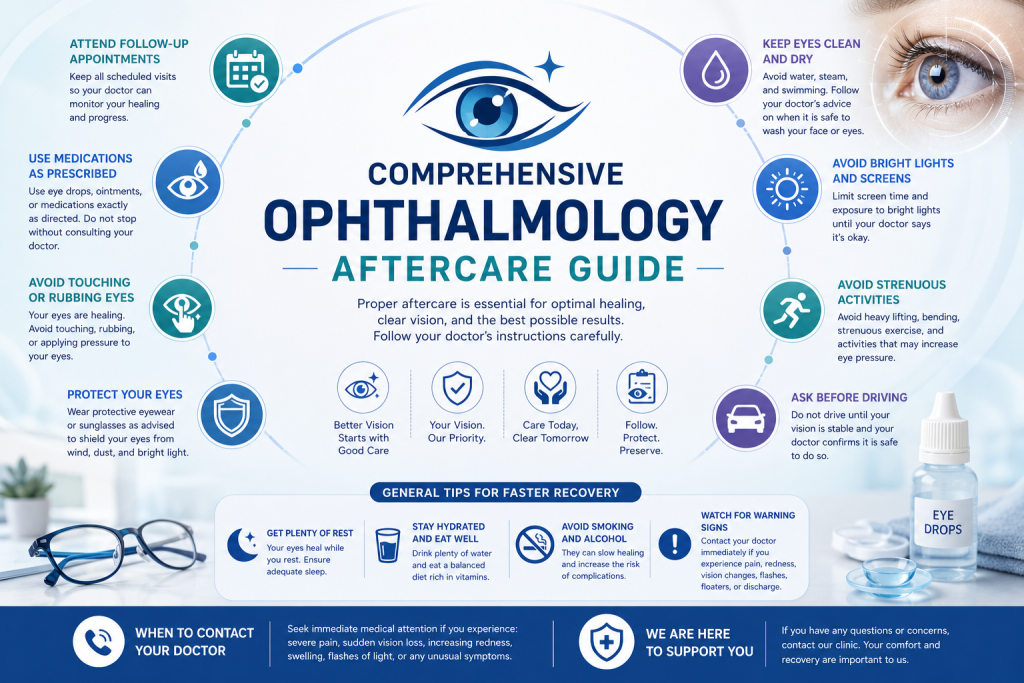
OPHTHALMOLOGY AFTERCARE GUIDES
1. LASIK (Laser-Assisted In Situ Keratomileusis) - Aftercare Guide
- Eyes will feel dry and may sting; this is normal
- Artificial tears and prescribed eye drops essential
- Avoid touching, rubbing, or pressing eyes
- Wear protective sunglasses to shield from light sensitivity
- Rest with eyes closed for first 2-3 hours
- Mild discomfort controlled with prescribed pain medication
- Attend mandatory next-day follow-up appointment
- Avoid water contact with eyes during showers and bathing
- Do not swim or use hot tubs
- Avoid strenuous exercise and heavy lifting
- Sleep with extra pillows to keep head elevated
- Continue frequent artificial tear application
- Vision may be slightly blurry; improves rapidly
- Avoid driving until cleared by surgeon
- Refrain from eye makeup and cosmetics
- No contact lens use until cleared
2. LASEK (Laser Epithelial Keratomileusis) - Aftercare Guide
- Bandage contact lens placed to protect cornea
- Eyes will feel irritated and scratchy (normal with LASEK)
- Pain management with prescribed medication
- Artificial tears and prescribed eye drops critical
- Avoid touching or rubbing eyes
- Wear sunglasses for light protection
- Rest with eyes closed
- Keep bandage contact lens dry
- Do not remove bandage contact lens (only surgeon removes)
- Eye drops applied frequently (4-6 times daily)
- Avoid water contact with eyes during showers
- Do not swim or use water-based activities
- Avoid strenuous exercise
- Pain and discomfort gradually decrease
- Vision remains blurry until corneal epithelium heals
- Sleep on back with head elevated
- Avoid dusty or dry environments
- Wear protective sunglasses outdoors
- No eye makeup or contact sports
3. SMILE (Small Incision Lenticule Extraction) - Aftercare Guide
- Minimal discomfort compared to LASIK/LASEK
- Mild grittiness and dry sensation normal
- Artificial tears and prescribed eye drops
- Avoid touching, rubbing, or pressing eyes
- Protective sunglasses for light sensitivity
- Rest with eyes closed
- Pain typically minimal; mild medication available
- Attend mandatory next-day follow-up appointment
- Avoid water contact during showers and bathing
- Do not swim or hot tubs
- Avoid strenuous exercise
- Sleep elevated on back
- Apply artificial tears frequently
- Vision may be slightly blurry; improves rapidly
- Avoid driving until cleared
- No eye makeup
- No contact lenses until cleared
4. ICL (Implantable Collamer Lens) - Aftercare Guide
- Eyes may feel gritty and slightly uncomfortable
- Mild pressure sensation in eye (normal)
- Prescribed eye drops critical (antibiotics, anti-inflammatory)
- Avoid touching or rubbing eyes
- Wear sunglasses for protection
- Rest with eyes closed
- Pain typically minimal
- Vision may be blurry initially
- Attend mandatory next-day follow-up appointment
- Avoid water contact during showers and bathing
- Do not swim or use hot tubs
- Avoid strenuous exercise and heavy lifting
- Sleep elevated on back
- Apply prescribed eye drops frequently (4-6 times daily)
- Vision begins clearing quickly
- Avoid driving until cleared by surgeon
- No eye makeup
- No contact lenses
5. Cataract Surgery - Aftercare Guide
- Eyes will feel tender and slightly uncomfortable
- Protective shield placed over eye to prevent trauma
- Prescribed eye drops (antibiotics, steroids, anti-inflammatory)
- Avoid touching, rubbing, or pressing eye
- Rest with eyes closed
- Avoid strenuous activity
- Pain typically minimal to moderate
- Vision may be blurry; normal immediately post-surgery
- Attend mandatory next-day follow-up appointment
- Wear protective eye shield during sleep for 1 week
- Keep eye dry; avoid water during showers and bathing
- Avoid strenuous exercise and heavy lifting
- Sleep elevated on back
- Apply prescribed eye drops frequently (4-6 times daily)
- Avoid bending or straining
- No swimming or water activities
- Vision begins clearing
- Avoid driving until cleared
6. PRK (Photorefractive Keratectomy) - Aftercare Guide
- Bandage contact lens placed over cornea
- Eyes feel uncomfortable and gritty (normal)
- Pain may be present; managed with medication
- Prescribed eye drops essential
- Avoid touching, rubbing, or pressing eyes
- Protective sunglasses for light sensitivity
- Rest with eyes closed
- Avoid strenuous activity
- Eye drops applied frequently (4-6 times daily)
- Bandage contact lens protects cornea (do not remove)
- Pain and discomfort gradually decrease
- Avoid water contact with eyes
- Do not swim or bathe eyes
- Avoid strenuous exercise
- Sleep elevated and on back
- Vision remains blurry until epithelial healing
- Wear protective sunglasses outdoors
- No eye makeup
- Attend follow-up appointments
7. Corneal Cross-Linking (CXL) - Aftercare Guide
- Bandage contact lens placed to protect cornea
- Eyes feel uncomfortable and scratchy
- Pain present; managed with medication
- Prescribed eye drops critical
- Avoid touching or pressing eyes
- Protective sunglasses for light
- Rest with eyes closed
- Apply artificial tears frequently
- Frequent prescribed eye drops (4-6 times daily)
- Bandage contact lens protects cornea (do not remove)
- Pain gradually improves
- Avoid water contact with eyes
- No swimming or bathing eyes
- Avoid strenuous exercise
- Sleep elevated on back
- Vision blurry during healing
- Wear protective sunglasses outdoors
- No eye makeup
- Attend follow-up appointments
8. Dry Eye Treatment (Advanced Procedures) - Aftercare Guide
- Mild discomfort in treated area
- Prescribed eye drops essential
- Avoid touching or rubbing eyes
- Rest with eyes closed
- Sunglasses for light protection
- Avoid strenuous activity
- Pain typically minimal
- Attend follow-up appointment
- Apply prescribed lubricating drops
- Avoid water contact if applicable
- Avoid strenuous exercise
- Sleep elevated on back
- Avoid eye makeup
- Vision may be slightly unclear initially
- No driving until cleared
- Avoid dusty environments
General Ophthalmology Aftercare Principles
Immediate Post-Operative Period (First 24 Hours)
- Never touch, rub, or press eyes after any procedure
- Prescribed eye drops are critical—use exactly as directed
- Avoid water contact with eyes until cleared
- Attend all scheduled follow-up appointments (next-day mandatory)
- Rest with eyes closed for first 2-3 hours
- Wear protective sunglasses for light protection
- Avoid strenuous exercise and heavy lifting
- Sleep elevated on back or treated side away
- Do not drive while taking eye medications
- Avoid eye makeup and cosmetics
- Avoid dusty or smoky environments
- Apply ice packs if recommended (wrapped in cloth, not directly on eye)
- Take prescribed pain medications as directed
- Drink plenty of water and non-alcoholic fluids
- Eat soft, cool foods; avoid hot foods and beverages
First Week
- Continue prescribed eye drops in exact frequency (typically 4-6 times daily)
- Avoid water contact with eyes during showers and bathing
- Do not swim, bathe, or use hot tubs
- Avoid strenuous exercise and heavy lifting
- Avoid bending or straining
- Wear protective sunglasses outdoors (UV protection essential)
- Sleep elevated on back, away from treated eye
- Avoid dusty, windy, or dry environments
- No eye makeup or contact sports
- Keep environment clean to prevent infection
- Maintain eye shield if prescribed (especially during sleep)
- Avoid touching, rubbing, or pressing eyes
- Continue artificial tears for dry eye symptoms
- Pat eyes gently if needed; never rub
- Report any sudden vision changes immediately
- Attend scheduled follow-up appointments
- Vision may fluctuate; this is normal
Weeks 2-4
- Continue prescribed eye drops (typically 3-4 times daily)
- Vision stabilizes and continues improving
- Can resume light activities and exercise
- Avoid direct sun exposure; use protective sunglasses
- No swimming or water activities until cleared
- Eye makeup acceptable if applied carefully (avoid getting in eye)
- Maintain regular follow-up appointments
- Dry eye symptoms may persist; manage with artificial tears
- Avoid harsh lighting and screens if irritated
- Continue eye protection outdoors
- Light walking and gentle exercise encouraged
- Avoid contact sports until fully cleared
- Report persistent discomfort to surgeon
Months 2-3 and Beyond
- Continue eye drops as directed by surgeon
- Vision continues refining (may take 3-6 months for final result)
- Most restrictions lifted by 6-8 weeks
- Full activity resumable after surgeon approval
- Dry eye management continues as needed
- UV protection remains important indefinitely
- Return to normal activities gradually
- Maintain annual eye exams
- Report any vision changes to eye care provider
- Some procedures require long-term monitoring
WARNING SIGNS: WHEN TO CONTACT YOUR SURGEON
Contact Immediately:
- Sudden vision loss
- Sudden eye pain not relieved by medication
- Excessive bleeding or hemorrhage
- Severe redness or swelling
- Pus or colored discharge
- Fever above 101°F (38.3°C)
- Flashes of light or new floaters
- Halo effects around lights (if sudden or worsening)
- Feeling of something in eye with pain
- Signs of infection (warmth, discharge, odor)
- Suture complications
- Severe light sensitivity
Contact Within 24 Hours:
- Mild fever (under 101°F)
- Mild discharge or tearing
- Increasing dryness unrelieved by drops
- Minor redness or irritation
- Questions about medications
- Concerns about healing progress
- Difficulty with prescribed eye drops
- Eye shield or dressing complications
Schedule Follow-Up Appointment:
- Next-day post-operative check (mandatory)
- One week post-operative
- One month post-operative
- Three month post-operative
- Six month post-operative (as needed)
- Annual comprehensive eye exams
- Additional appointments if complications arise
ESSENTIAL DO'S AND DON'TS
DO:
- Follow all surgeon's instructions carefully
- Use prescribed eye drops exactly as directed
- Attend all follow-up appointments
- Wear protective sunglasses outdoors
- Keep eyes protected from dust and wind
- Use artificial tears frequently if dry
- Report vision changes immediately
- Maintain clean hands when near eyes
- Set reminders for eye drop schedules
- Keep follow-up contact information readily available
- Use only sterile eye drop containers
- Apply drops to lower lid only
- Close eyes gently after drop application
- Rest eyes frequently, especially from screens
- Maintain a clean environment
DON'T:
- Don't touch, rub, or press eyes
- Don't remove eye shields or bandage contact lens yourself
- Don't expose eyes to water (showers, pools, hot tubs)
- Don't engage in strenuous exercise
- Don't apply eye makeup until cleared
- Don't wear contact lenses until cleared
- Don't expose eyes to dust or smoke
- Don't drive while taking pain medications
- Don't skip prescribed eye drops
- Don't use old or contaminated eye drop bottles
- Don't apply drops directly to cornea
- Don't sleep face-down on treated eye
- Don't strain or bend excessively
- Don't swim or dive until fully cleared
- Don't hesitate to call surgeon with concerns
LONG-TERM VISION CARE
Vision Refinement
- Vision continues improving over days to weeks
- Some procedures take 3-6 months for final result
- Fine vision adjustments may occur for up to 6-12 months
- Enhancement procedures possible if needed
- Vision may continue refining during this period
- Fluctuation in vision is normal during healing
Dry Eye Management
- Dry eyes common after most eye procedures
- Use preservative-free artificial tears
- Apply tears frequently (hourly if needed)
- Avoid dry environments and air conditioning
- Maintain home humidity with humidifier
- Take breaks from screens
- Reduce screen time initially
- Blink consciously and regularly
- Avoid prolonged reading initially
- Long-term dry eye management may be necessary
Sun Protection
- UV-protective sunglasses essential outdoors
- Protects eyes from UV damage
- Use daily even on cloudy days
- Wear during all outdoor activities
- Critical for first 6-12 months post-op
- Maintains long-term eye health
- Prevents complications and discomfort
New Eyeglass Prescription
- Eyeglass prescription stabilizes after healing
- Wait until final vision achieved (3-6 months)
- New prescription needed for reading glasses or backup
- Distance vision typically stabilizes faster
- Discuss vision correction options with eye care provider
- Some procedures reduce need for glasses significantly
Ongoing Eye Care
- Annual comprehensive eye exams recommended
- Report any vision changes to eye care provider
- Monitor for dry eye symptoms long-term
- Maintain overall eye health habits
- Protective eyewear in hazardous situations
- Continue sun protection indefinitely
- Keep records of all post-operative measurements
- Maintain contact with surgical clinic for questions
SPECIAL CONSIDERATIONS FOR INTERNATIONAL PATIENTS
Pre-Departure Guidelines
- Schedule final clearance appointment before flying
- Most patients cleared to fly 24-48 hours post-op
- Obtain written post-operative care instructions
- Get copies of all test results and prescriptions
- Request enough eye drops for travel home
- Plan for time zone changes (adjust drop schedule)
- Arrange telemedicine follow-ups if available
- Obtain surgeon's direct contact information
- Keep copies of all documentation in carry-on
Travel Precautions
- Avoid air travel immediately after surgery if possible
- Airplane cabin air may cause dry eyes; use drops frequently
- Wear protective sunglasses during travel
- Protect eyes from airport dust and wind
- Bring prescribed eye drops in carry-on bag
- Avoid touching eyes during travel
- Rest eyes during long flights
- Maintain clean hands throughout travel
- Avoid sleeping face-down on pillows
Ongoing International Care
- Telemedicine follow-ups arranged with Korean clinic
- Email or video consultations possible for routine checks
- Emergency contact numbers provided for home country
- Referrals to ophthalmologists in home country
- Medical records provided for local follow-up
- Maintain contact with Korean clinic for long-term questions
- Report any concerns to both clinics for continuity
- Annual eye exams in home country recommended
- Keep all documentation for future reference