
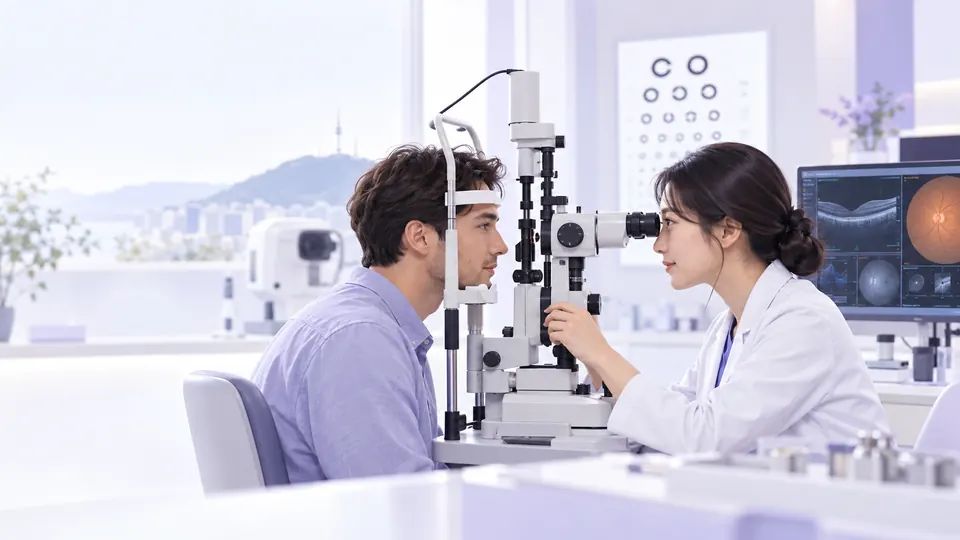


Foreign visitors can book comprehensive eye exams, vision assessments and dry-eye evaluations in Korea. The right appointment depends on whether your main concern is general eye health, changing vision, retinal or glaucoma screening, contact-lens discomfort or persistent dry-eye symptoms.
A comprehensive eye exam is more than a basic vision test. Depending on your symptoms and risk factors, it may include eye-pressure measurement, examination of the front and back of the eye, OCT or retinal imaging, pupil dilation and dry-eye testing. Cost and appointment time depend mainly on which tests are needed.
What is the difference between a vision test and a comprehensive eye exam?
A vision test mainly checks how clearly you can see and whether your glasses or contact-lens prescription may have changed. A medical eye examination can look more broadly at the health of the eye itself.
That difference matters when choosing an appointment. If your only goal is updating a prescription, you may not need the same examination as someone with persistent dry eyes, a family history of glaucoma, diabetes or concerns about the retina.
Usually focuses on visual acuity, refraction and whether your prescription needs to change.
Depending on the reason for the visit, an ophthalmologist may also check eye pressure, the cornea, retina, optic nerve, tear film and other eye structures.
Who may want to consider an eye exam in Korea?
Some people book an eye exam because something feels different. Others simply want a broader eye-health check while they are in Korea. A planned examination may be worth considering if any of the following sounds familiar.
- Your vision has become blurry or your prescription seems to be changing.
- Your eyes often feel dry, gritty, burning or unusually tired.
- You spend long hours on screens and experience frequent eye strain.
- You regularly wear contact lenses and have discomfort or fluctuating vision.
- You have diabetes or another condition for which periodic eye monitoring has been recommended.
- You have a family history of glaucoma or significant eye disease.
- You have not had a comprehensive eye examination for a long time.
- You are considering LASIK, SMILE or ICL and need a separate refractive-surgery evaluation.
What type of eye appointment do you need?
Start with your main concern. A general eye-health check, a dry-eye evaluation and a refractive-surgery screening are different visits and may involve different tests.
| Your Main Goal or Symptom | More Relevant Visit | What May Be Considered |
|---|---|---|
| General eye-health check | Comprehensive eye exam | Vision, eye pressure and broader examination of eye health as clinically indicated |
| Retina or glaucoma concerns | Comprehensive exam + imaging | OCT, retinal imaging, pressure testing or dilation where appropriate |
| Dry, gritty, burning or irritated eyes | Dry-eye evaluation | Tear-film quality, tear stability, inflammation and meibomian-gland function |
| Screen fatigue or contact-lens discomfort | Refraction + ocular-surface evaluation | Vision changes, tear film and lens-related irritation |
| Blurred or changing vision | Ophthalmic examination | Refraction plus additional testing based on age, symptoms and examination findings |
| LASIK / SMILE / ICL eligibility | Refractive-surgery screening | Corneal mapping, refraction and surgery-specific measurements |
What tests can be included in a comprehensive eye exam?
There is no single test package that every patient needs. The ophthalmologist chooses tests according to your symptoms, eye history, risk factors and the reason for the visit.
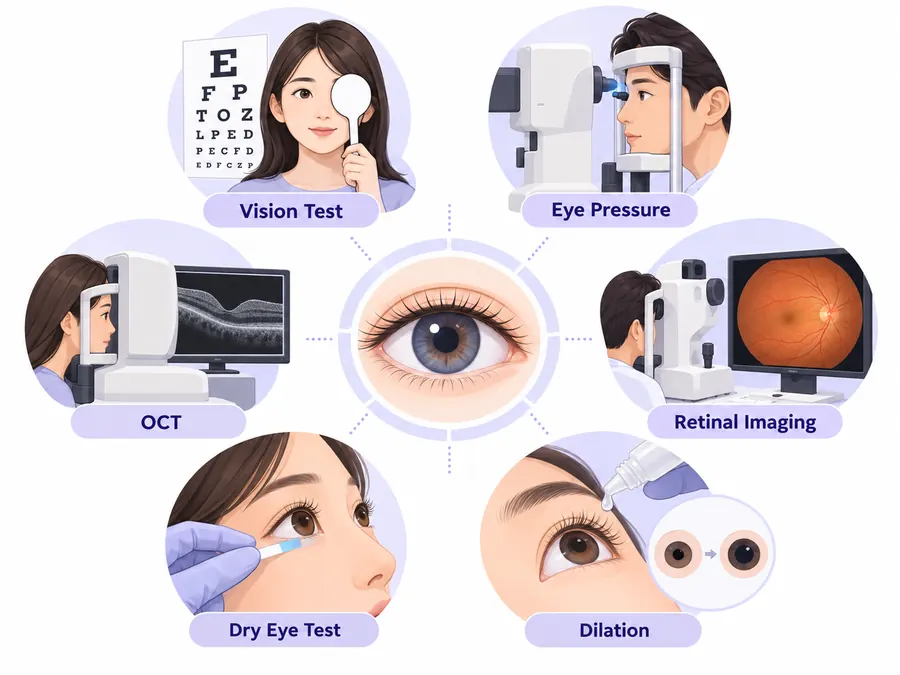
- Visual acuity & refraction Checks how clearly you see and whether corrective lenses may be needed.
- Eye-pressure measurement Measures intraocular pressure as one part of glaucoma assessment.
- Front-of-eye examination Allows the doctor to examine structures such as the cornea, eyelids and lens.
- OCT Produces cross-sectional images of structures such as the retina or optic nerve when clinically indicated.
- Retinal imaging Can document a wider view of the back of the eye.
- Dry-eye testing May assess tear-film stability, tear quality, inflammation and meibomian-gland function.
- Visual-field testing May be used when peripheral vision or glaucoma risk needs assessment.
- Pupil dilation May be recommended when the ophthalmologist needs a broader view inside the eye.
How much does an eye exam cost in Korea for foreigners?
Eye-exam prices vary because a basic ophthalmology visit and a comprehensive package with imaging or dry-eye diagnostics do not include the same tests.
Provider-reported information supplied to MTK indicates an international comprehensive eye-checkup range of approximately ₩150,000–₩200,000.
The same provider information indicates an examination time of about 40 minutes, with results available later the same day.
The final cost depends on whether the visit involves dry-eye diagnostic testing, in-clinic care or a broader eye examination.
Clinic-provided information also describes an Aqua Care dry-eye program designed to combine evaluation and in-clinic care within approximately one hour.
*OLIM price, appointment-time and same-day-result information is provider-reported to MTK and should be reconfirmed for the requested appointment date.
Why don't artificial tears solve every dry-eye problem?
Dry eye is not always simply a problem of having too little tear fluid. In some people, the tear film is unstable or the oily layer produced by the eyelid's meibomian glands does not function normally, allowing tears to evaporate too quickly.
That is why a dry-eye visit can involve more than a basic vision test. Clinics may assess tear-film stability, tear osmolarity, ocular-surface inflammation and meibomian-gland function before deciding which type of care is relevant.
Current evidence: TFOS DEWS III describes dry eye as a multifactorial, symptomatic disease involving loss of tear-film or ocular-surface homeostasis. Tear-film instability, hyperosmolarity, inflammation, ocular-surface damage and neurosensory abnormalities can all play a role, which is why diagnosis should look beyond symptoms alone.
Which clinics can international patients consider for eye exams in Korea?
Different clinics may be useful for different reasons. Some emphasize broad eye-health screening and diagnostic imaging, while others have more detailed dry-eye testing and treatment pathways.
The clinics below are presented for comparison. Listing order does not indicate preference.
| Clinic | Area | May Suit | Main Eye-Care Focus | Price / Time |
|---|---|---|---|---|
| OLIM Eye Clinic | Gangnam-gu, Seoul | Broad eye-health screening and diagnostic imaging | Eye Examination Center, 50+ precision-test system, OCT and ultra-widefield retinal imaging | Provider-reported: ₩150,000–₩200,000; approximately 40 min* |
| B&VIIT Eye Center | Gangnam Station area, Seocho-gu, Seoul | Dry, gritty, tired or irritated eyes | K5M, Tear Lab, MMP-9, meibomian-gland evaluation and dry-eye care | Current quote required; Aqua Care approximately 1 hour* |
*Provider-reported information; confirm current package details before booking.
OLIM Eye Clinic — Gangnam-gu, Seoul
View OLIM Eye Clinic on MTK →
OLIM Eye Clinic may be relevant for patients who want a broader eye-health assessment rather than only a glasses prescription or surgery consultation. Its official clinic information identifies a dedicated Eye Examination Center where more than 50 precision tests can be performed within the clinic's screening system.
OLIM's published retinal equipment includes the Topcon Maestro2 OCT and Optos Daytona. The clinic describes the Optos system as capable of capturing approximately 200 degrees of the retina, supporting broader retinal imaging when that examination is needed.
- May suit: International patients looking for a comprehensive eye-health check with access to diagnostic imaging.
- Eye-exam system: Dedicated examination center with a screening system covering more than 50 precision tests.
- Published imaging: Topcon Maestro2 OCT and Optos Daytona ultra-widefield retinal imaging.
- Provider-reported price: Approximately ₩150,000–₩200,000 for the international checkup package.
- Provider-reported time: Approximately 40 minutes, with results available later the same day.
- Languages: English, Simplified Chinese and Thai are currently listed in MTK clinic data.
- Address: 546 Nonhyeon-ro, Gangnam-gu, Seoul, 2F–5F.
B&VIIT Eye Center — Gangnam Station area, Seoul
View B&VIIT Eye Center on MTK →
B&VIIT Eye Center may be more relevant when the main complaint is dryness, grittiness, burning, tired eyes or discomfort associated with screen use or contact lenses. Its official dry-eye information focuses on identifying the factors behind the symptoms rather than treating every case in exactly the same way.
The clinic publishes several dry-eye diagnostic tests. Its K5M system evaluates tear-film breakup, tear height and meibomian-gland structure and function. Tear Lab measures tear osmolarity, while MMP-9 testing assesses inflammatory markers on the ocular surface.
- May suit: Patients whose main concern is persistent dry, gritty, irritated or tired eyes, including contact-lens discomfort.
- Dry-eye testing: K5M tear-film and meibomian-gland evaluation, Tear Lab osmolarity testing and MMP-9 ocular-surface inflammation testing.
- Published care options: LipiFlow, Dry Eye IPL, HiLight and meibomian-gland care.
- Aqua Care: Clinic-provided information describes an approximately one-hour dry-eye program combining evaluation and in-clinic care.
- Current price: Confirm the current dry-eye evaluation or treatment package with MTK.
- Languages: English and Simplified Chinese are currently listed in MTK clinic data.
- Address: 411 Seocho-daero, Seocho-gu, Seoul, B2F.
What should travelers know before an eye exam in Korea?
Most eye appointments are easy to fit into a Seoul itinerary, but some tests can affect what you should plan immediately afterward. Pupil dilation and contact-lens instructions are the two things worth checking before the visit.
If your pupils are dilated, your eyes may be more sensitive to light for several hours.
Dilation can temporarily blur vision. If dilation may be needed, plan public transport, a taxi or another ride.
OCT, retinal imaging, dry-eye testing or pupil dilation can make the visit longer than a basic vision check.
Will I need my pupils dilated?
Not every eye examination requires dilation. It may be recommended when the ophthalmologist needs a better view of the retina, optic nerve or other structures inside the eye.
After dilation, near vision can become blurry and the eyes may be more sensitive to light for several hours. If your travel schedule is tight, ask the clinic in advance whether dilation is likely to be part of your examination.
Should I stop wearing contact lenses before an eye exam?
There is no single stop-wearing rule for every type of eye appointment. For a routine eye-health visit, instructions depend on the tests the clinic plans to perform.
Contact lenses can temporarily alter corneal measurements, so clinics may ask you to leave lenses out in advance when the appointment includes corneal topography or refractive-surgery screening. The required period differs by lens type and examination, so ask the clinic before your visit rather than using a general rule.
What should I bring to an eye appointment in Korea?
You usually do not need much, but a few details can make the examination and consultation easier.
- Your current glasses, especially if your prescription has recently changed.
- Information about the contact lenses you normally wear.
- A list of eye drops and relevant medications.
- Previous eye records if you have glaucoma, retinal disease or previous eye surgery.
- Identification requested by the clinic or booking service.
- Sunglasses if pupil dilation may be needed.
When is an eye problem more urgent than a routine travel checkup?
A sudden increase in new floaters, flashes of light, a dark curtain or shadow moving across the field of vision, sudden major vision loss or severe eye pain should not be saved for a routine travel appointment. These symptoms can require urgent medical assessment.
How can an international patient arrange an eye exam in Korea?
The easiest way to start is to describe the problem rather than trying to choose every individual test yourself. The clinic can then determine which examination pathway is more appropriate.
General eye check, dry eye, blurred vision, contact-lens discomfort, retina or glaucoma screening, or another issue.
Provide your preferred date, travel schedule and required language support.
Confirm the current price, likely appointment time, whether dilation may be needed and any contact-lens instructions.
Common questions about eye exams in Korea
How much does an eye exam cost in Korea for foreigners?
There is no single nationwide price. Cost depends on whether you need a basic ophthalmology consultation, a comprehensive examination, diagnostic imaging or dry-eye testing. Provider-reported information for OLIM's international checkup package is approximately ₩150,000–₩200,000.
Can foreigners book an eye exam in Seoul?
Yes. Seoul ophthalmology clinics may offer services for international patients, but language support differs by clinic. Confirm the language you need when arranging the appointment.
How long does a comprehensive eye exam take?
It depends on the tests included. Provider-reported information for OLIM's international checkup is approximately 40 minutes, while appointments involving dilation, additional imaging or dry-eye testing may take longer.
Can I get eye-exam results on the same day?
This depends on the clinic and the tests performed. OLIM has reported to MTK that results for its international checkup package can be available later the same day.
What tests are included in a comprehensive eye exam?
The exact tests depend on your symptoms and risk factors. They may include visual acuity and refraction, eye-pressure measurement, examination of the front and back of the eye, OCT, retinal imaging, visual-field testing or dilation.
Where can I get dry-eye testing in Seoul?
B&VIIT Eye Center publishes a dedicated dry-eye testing pathway using K5M, Tear Lab and MMP-9, together with meibomian-gland evaluation. Other ophthalmology clinics may also provide dry-eye assessment, so compare the testing available for your symptoms.
Can dry-eye care be completed in one visit?
Some evaluation and in-clinic care can be performed during one appointment, but dry eye can require ongoing management. Clinic-provided information describes B&VIIT's Aqua Care as an approximately one-hour program, while the appropriate plan depends on examination findings.
Should I stop wearing contact lenses before the exam?
Ask the clinic first. Requirements depend on the examination. Contact lenses can alter corneal measurements, which is particularly relevant when corneal mapping or refractive-surgery screening is planned.
Will my pupils be dilated?
Not always. Dilation may be recommended when the ophthalmologist needs a wider view of the retina or other internal eye structures. Vision can be temporarily blurry and light sensitivity can increase afterward, so plan the rest of your day accordingly.
Which sources support the medical and clinic information in this guide?
- MTK — OLIM Eye Clinic . Current clinic entity, location, treatment category and language information.
- OLIM Eye Clinic — Official Clinic Preview . Eye Examination Center and 50+ precision-test system.
- OLIM Eye Clinic — Official Retina & Imaging Information . Topcon Maestro2 OCT and Optos Daytona ultra-widefield retinal imaging.
- MTK — B&VIIT Eye Center . Current clinic entity, address, treatment category and language information.
- B&VIIT Eye Center — Official Dry Eye Information . K5M, Tear Lab, MMP-9, LipiFlow, Dry Eye IPL and other published dry-eye information.
- National Eye Institute — Dilated Eye Exam . Examination components, pupil dilation, temporary blurry vision and light sensitivity.
- National Eye Institute — Retinal Detachment . Urgent warning symptoms including sudden floaters, flashes and curtain-like shadows.
- TFOS DEWS III: Diagnostic Methodology . Current evidence-based dry-eye definition, diagnostic approach and etiological assessment.
- U.S. FDA — LASIK Baseline Evaluation Guidance . Contact-lens effects on corneal measurements before refractive-surgery evaluation.
Need help choosing the right eye exam in Korea?
Tell MTK your main concern — general eye checkup, dry eye, blurred vision, contact-lens discomfort, retina or glaucoma screening, or another eye-health question. Include your travel dates and preferred language, and MTK can help check the current clinic options, price and appointment availability.
The ophthalmologist determines which tests are appropriate after reviewing your symptoms, eye history and examination needs. Sudden severe or sight-threatening symptoms should be assessed urgently rather than through a routine travel appointment.